
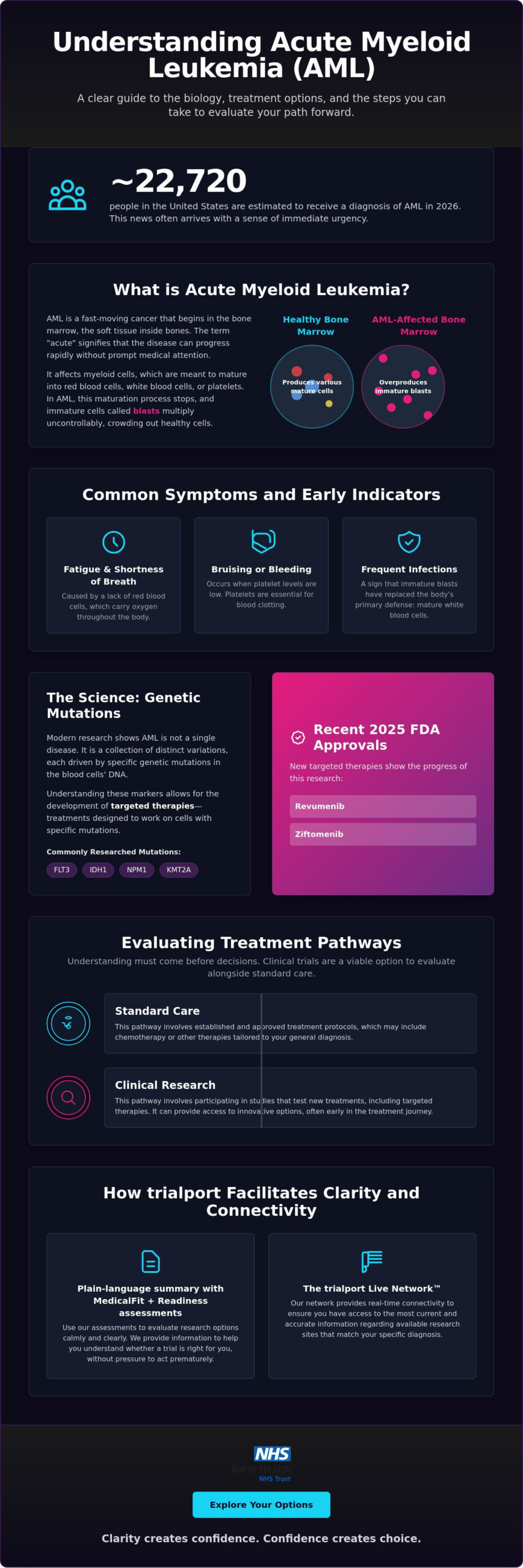
The American Cancer Society estimates that approximately 22,720 people will receive a diagnosis of leukemia (Acute myeloid leukaemia (AML) in the United States during 2026. This news often arrives with little warning and a sense of immediate urgency. It’s natural to feel overwhelmed by the rapid pace of clinical conversations and the complex medical jargon that follows. You might feel a pressure to act before you fully understand the landscape of your care.
trialport provides a framework where understanding must come before decisions. This guide provides a clear, calm overview of the biology of the disease and the steps you can take to evaluate your options. We’ll explore the latest treatment standards, including recent 2025 FDA approvals for targeted therapies like revumenib and ziftomenib. You’ll also learn how to use a plain-language summary with MedicalFit + Readiness assessments to determine if clinical research is the right path for your journey. Clarity creates confidence, and confidence creates choice.
Key Takeaways
- Leukemia (Acute myeloid leukaemia (AML) is a fast-moving bone marrow cancer that requires a clear understanding of biological progression before making treatment choices.
- Modern research focuses on specific genetic mutations to create targeted therapies that provide more precise options for managing the disease.
- Clinical trials are often a viable option early in the treatment journey and should be evaluated alongside standard care methods.
- You can use a plain-language summary with MedicalFit + Readiness assessments to evaluate research options without feeling pressured to act prematurely.
- The trialport Live Network™ provides real-time connectivity to ensure you have access to the most current and accurate information regarding available research sites.
Understanding Acute Myeloid Leukemia (AML) and its Impact
A diagnosis of leukemia (Acute myeloid leukaemia (AML) often feels like a sudden disruption to your life. It is a type of cancer that begins in the bone marrow, the spongy tissue found inside your bones. The term “acute” indicates that the disease typically progresses rapidly without intervention. It requires prompt medical attention. This sense of urgency can make clear thinking difficult for patients and their families. Understanding the basic mechanics of the condition is the first step toward regaining a sense of agency. You may find a detailed Acute Myeloid Leukemia Overview helpful for establishing a foundational understanding of the disease.
The word “myeloid” refers to the specific lineage of blood cells affected during their development. These cells are intended to become mature red blood cells, white blood cells, or platelets. In AML, the genetic instructions within these cells change. The maturation process stops prematurely. This interruption changes the composition of your blood. It impacts how your body functions on a fundamental level. When managing leukemia (Acute myeloid leukaemia (AML), recognizing these biological changes helps you participate more effectively in clinical discussions. trialport is designed to help you understand whether a trial is right for you by providing clear, accessible information.
The Role of Bone Marrow in AML
Bone marrow serves as the factory for your red blood cells, white blood cells, and platelets. It is the essential soft tissue where blood cells begin their life cycle. In a healthy system, the marrow releases mature, functional cells into the bloodstream as they are needed. In AML, the marrow produces immature cells called blasts instead of healthy blood cells. These blast cells do not function correctly and begin to multiply uncontrollably. They eventually crowd out healthy cells within the marrow space. This crowding prevents the production of the vital components your body needs to transport oxygen, fight infection, and clot blood.
Common Symptoms and Early Indicators
The symptoms of AML are direct reflections of these cellular changes in the bone marrow. You may experience several physical indicators as healthy blood cell counts begin to drop:
- Fatigue and shortness of breath: These often occur due to a lack of red blood cells, which are responsible for carrying oxygen throughout the body.
- Bruising or bleeding: This can happen when platelet levels are low. Platelets are essential for clotting, and a deficiency makes you more susceptible to injury.
- Frequent infections: This may indicate that white blood cells are not protecting the body. When blasts replace mature white cells, the immune system loses its primary defense against pathogens.
Recognizing these signs is an important part of the navigation process. It allows you to articulate your experience to clinical professionals with greater precision. Clarity regarding your physical state helps you evaluate potential pathways with more confidence.
The Biology of AML Progression and Current Research
Every case of leukemia (Acute myeloid leukaemia (AML) is driven by a unique set of genetic instructions. These instructions, known as mutations, dictate how cancer cells grow and divide within the bone marrow. Scientists no longer view AML as a single, uniform disease. It is a collection of distinct genetic variations that require specific approaches. Understanding the biology of your specific case helps you ask better questions during clinical consultations. It allows you to move from a state of general uncertainty to one of focused inquiry.
Researchers study these mutations to develop more precise ways to support the body. This scientific focus has led to a shift in how we evaluate AML Treatment Options and research pathways. The trialport Live Network™ facilitates this process by connecting research sites with individuals who possess specific genetic markers. This real-time connectivity ensures that the right information reaches the right people at the right time. If you need help identifying which research paths align with your diagnosis, you can contact our team for guidance.
Genetic Mutations and Biomarkers
Mutations are specific errors in the DNA of blood cells. Common mutations such as FLT3, IDH1, NPM1, and KMT2A are frequent subjects of modern clinical research. A biomarker is a biological sign that helps doctors understand your specific disease profile. Testing for these markers is now a standard part of the diagnostic process. These markers act as a map for your care team. They indicate which targeted therapies might be most effective for your specific biological makeup. Identifying these markers early is essential for making an informed choice about research participation.
How Research is Evolving in 2026
Modern research in 2026 focuses on targeted therapies that address specific genetic errors. These treatments aim to block the signals that tell cancer cells to multiply. This approach differs from traditional methods by attempting to spare healthy cells from damage. Recent milestones include the October 2025 FDA approval of revumenib and the November 2025 approval of ziftomenib for patients with specific mutations. Scientists are also working to reduce the toxicity of standard treatments to improve quality of life. Clinical trials provide a pathway for people to access these emerging methods before they become widely available. This evolution in research prioritizes overall survival and durable responses. It reflects a commitment to creating more sustainable outcomes for everyone affected by leukemia (Acute myeloid leukaemia (AML).
Evaluating Treatment Pathways and Clinical Research Options
Choosing a path after a diagnosis of leukemia (Acute myeloid leukaemia (AML) requires a careful evaluation of all available options. Standard care typically begins with intensive chemotherapy. This treatment aims to clear the bone marrow of blast cells to allow healthy blood production to resume. While chemotherapy remains a foundational approach, it is not the only route available to you. You can find more foundational information in this American Cancer Society overview of AML. Understanding these options early helps you maintain a sense of control over your care plan.
Clinical trials are often misunderstood as a secondary or “last ditch” option. This is a common misconception that can limit your access to emerging care. In reality, participation in a trial can happen at various stages of your journey. Some trials are designed for people who are newly diagnosed and have not yet started any treatment. Others focus on those whose disease has returned after a period of remission. Every trial is structured to answer a specific scientific question about safety or effectiveness. trialport helps you understand whether a trial is right for you by providing a decision-support layer based on clear information. This clarity ensures that you’re making a choice based on data rather than anxiety.
Standard Care vs. Clinical Trial Participation
Standard care uses treatments that are already widely accepted and proven through previous research. These protocols are established and predictable. Clinical trials evaluate new possibilities that may eventually become the standard care of tomorrow. They offer a different level of oversight and specific goals. Standard care focuses on providing the current best-known treatment through hospital protocols. Clinical trials focus on evaluating new methods for safety and efficacy under the rigorous monitoring of research teams. Access to standard care is widely available at most hospitals. Clinical research is typically located at specific sites that have the infrastructure to support the study.
The Importance of Eligibility and Fit
Trials have specific criteria to ensure the safety of all participants and the integrity of the research data. Eligibility is based on concrete factors like your age, health history, and specific genetic markers. You should feel empowered to review these criteria with your medical team. trialport provides a plain-language summary with MedicalFit + Readiness assessments to help you determine your fit for a specific study. This tool allows you to activate your own decision-making process without feeling pressured by time or complex terminology. Understanding these requirements is a vital part of finding a path that aligns with your personal health goals. Clarity improves decision quality.
Navigating the Decision to Join a Clinical Trial
Making a choice about a clinical trial requires a baseline of clear information. You should never feel pressured to act before you fully understand the implications of your care. The diagnosis of leukemia (Acute myeloid leukaemia (AML) often creates a sense of manufactured urgency. While the disease moves quickly, your understanding must keep pace with the decisions you are asked to make. A plain-language summary with MedicalFit + Readiness assessments can help clarify your status and suitability for a specific study. This tool acts as a decision-support layer to help you process complex clinical data at your own speed. It helps you distinguish between the biological necessity of treatment and the personal choice of research participation.
Questions to Ask Your Hematologist
Your medical team is your primary source of information. You should feel comfortable asking direct questions to ensure you have a complete picture of the research path. Start with these foundational inquiries:
- What is the primary goal of this specific clinical trial?
- How does the trial treatment differ from the standard care I would receive?
- What are the known risks and potential benefits of this participation?
- Will I be responsible for any costs associated with the trial?
Asking these questions helps you move from passive observation to active participation. It ensures that the clinical team understands your priorities and respects your boundaries. You are an essential partner in this process, and your voice matters. Gathering this information is a vital step in making an informed choice that aligns with your health needs.
Understanding Your Rights as a Participant
Informed consent is a continuous process and not a one-time signature. It is a dialogue between you and the research staff that remains open throughout the study. You have the right to receive updates about the trial as new information becomes available. Participants have the right to withdraw from a trial at any time for any reason. This choice is yours alone and will not affect the quality of your standard care. The trial navigation service at trialport exists to help you understand these rights. You can learn more about clinical trials for patients to build your confidence. Ethical research depends on your ability to make an independent, informed choice.
Every journey with leukemia (Acute myeloid leukaemia (AML) is unique. Your choice should reflect your personal values, your family situation, and your specific health goals. If you find the process confusing or overwhelming, you can reach out to us for support in navigating these choices. We believe that clarity creates confidence. This confidence allows you to make decisions that feel right for your future. Understanding comes first. Decisions follow.
autoseo-infographic
/autoseo-infographic
How trialport Facilitates Clarity and Connectivity
The path through a leukemia (Acute myeloid leukaemia (AML) diagnosis is often obscured by outdated information and fragmented data. trialport acts as a bridge between these complex systems and the people who need them most. We provide a decision-support layer that prioritizes your need for clarity before any action is taken. Our professional navigation service guides you through the entire lifecycle of a trial to ensure you never feel lost in the process. This approach moves away from simple recruitment lists and toward a model of genuine understanding. We believe that informed patients make better choices for their health and their families.
The trialport Live Network™ Advantage
The trialport Live Network™ connects research sites and sponsors in real-time. This connectivity ensures that trial information is current and accurate at every stage of the study. Most platforms rely on static data that may not reflect the actual status of a site or its current enrollment needs. Real-time data flow reduces the bottlenecks often found in clinical research. Sites can communicate their specific requirements and availability directly to those seeking trials. This system creates a more efficient ecosystem for everyone involved in the research community. It eliminates the frustration of pursuing options that are no longer active or relevant. You can explore our clinical research connectivity solutions to understand how this infrastructure supports better outcomes.
Tools for Informed Decision Making
We provide a plain-language summary with MedicalFit + Readiness assessments for each trial on our platform. These tools are designed to help people understand whether a trial is right for them by translating technical criteria into accessible language. You can evaluate your suitability for a study without the pressure of clinical jargon or time-sensitive recruitment tactics. This assessment process gives you the space to reflect on how a trial fits into your life. Clarity is the foundation of every confident choice made on our platform. This methodical approach ensures that your transition from learning to acting is entirely driven by your own pace. For more information, read our clinical trial navigation services: a guide to clarity.
The goal of trialport is to lower the temperature of the search process for those living with leukemia (Acute myeloid leukaemia (AML). We believe that when you have the right tools, the anxiety of the unknown is replaced by a sense of calm confidence. Our platform acts as a protective intermediary between you and the complexity of the medical system. Your journey is your own. We are here to provide the support you need to make the right choice for your future.
Clarity creates confidence. Confidence creates choice.
Building a Foundation for Informed Care
Navigating a diagnosis of leukemia (Acute myeloid leukaemia (AML) is a process that requires patience and precise information. You now understand that genetic markers are keys to unlocking targeted treatment pathways. Clinical research represents a proactive way to access these emerging therapies at various stages of your journey rather than a final resort. By using the trialport Live Network™ and our plain-language summary with MedicalFit + Readiness assessments, you can move past the noise of complex jargon to find what truly matters. Our professional trial navigation services are here to ensure that your path remains clear and manageable. You have the right to understand every implication of your care before you choose to act. We believe that integrity and transparency are the pillars of ethical support. This journey belongs to you, and we are here to provide the clarity you deserve.
Clarity creates confidence. Confidence creates choice. Discover how trialport supports your navigation journey.
Frequently Asked Questions
Is Acute myeloid leukemia (AML) considered curable in 2026?
Leukemia (Acute myeloid leukaemia (AML) can be curable for many patients, particularly those who achieve complete remission through intensive therapy or stem cell transplants. The 5-year overall survival rate for AML is approximately 32 percent as of 2026. Outcomes depend heavily on the specific genetic mutations present and the age of the patient. New targeted therapies are continuing to improve the possibility of long-term survival for many individuals.
What is the difference between AML and other types of leukemia?
Leukemia (Acute myeloid leukaemia (AML) is distinguished by its rapid progression and the specific lineage of cells it affects. Unlike chronic leukemias, which develop over several years, AML requires immediate medical intervention. It originates in the myeloid line of blood cells rather than the lymphoid line. This distinction is vital because it determines which chemotherapy protocols or targeted research pathways are most appropriate for your specific diagnosis.
How much does it cost to participate in an AML clinical trial?
Most clinical trial sponsors cover the cost of the investigational treatment and any additional tests required specifically for the study. You are typically still responsible for standard care costs, such as routine hospital stays or physician consultations. It’s essential to review the financial disclosure section of the informed consent document carefully. Your medical team can help you understand which specific expenses will be billed to your insurance provider.
What happens if I decide to leave a clinical trial early?
You have the right to withdraw from a clinical trial at any time and for any reason without penalty. Leaving a study early won’t affect your access to standard medical care or your relationship with your healthcare providers. If you choose to leave, your medical team will transition you back to the most appropriate standard treatment plan. Your safety and personal choices always remain the highest priority throughout the process.
Can I participate in a trial if I am already receiving chemotherapy?
Participation depends entirely on the specific eligibility criteria of the trial protocol. Some studies are designed for individuals who are currently receiving or have just completed chemotherapy. Other trials focus on those who haven’t yet started any treatment. You should review your current treatment status with your medical team to see if it aligns with the requirements of a specific research protocol or targeted therapy study.
How does trialport help me find a trial that fits my specific genetic markers?
The trialport Live Network™ connects research sites and sponsors in real-time to match participants with studies seeking specific genetic markers. This connectivity ensures that you receive information about trials that are relevant to your unique biological profile. Instead of searching through static lists, you gain access to a dynamic system that prioritizes accuracy and scientific fit. This approach helps you identify the most promising research paths with calm confidence.
What is a plain-language summary with MedicalFit + Readiness assessments?
A plain-language summary with MedicalFit + Readiness assessments is a decision-support tool that translates complex clinical protocols into understandable English. It evaluates your health history and personal readiness against the specific requirements of a study. This assessment helps you understand whether a trial is right for you without the pressure of medical jargon. It’s designed to activate your independent decision-making process by providing a clear, transparent foundation of knowledge.
How long does the enrollment process typically take for an AML trial?
The enrollment timeline varies depending on the trial but often moves quickly due to the acute nature of the disease. Screening procedures, such as blood tests and bone marrow biopsies, typically take several days to two weeks to complete. These steps ensure that the study is safe and appropriate for your specific condition. Your trial navigator can provide more precise timing based on the requirements of the specific site you’re considering.