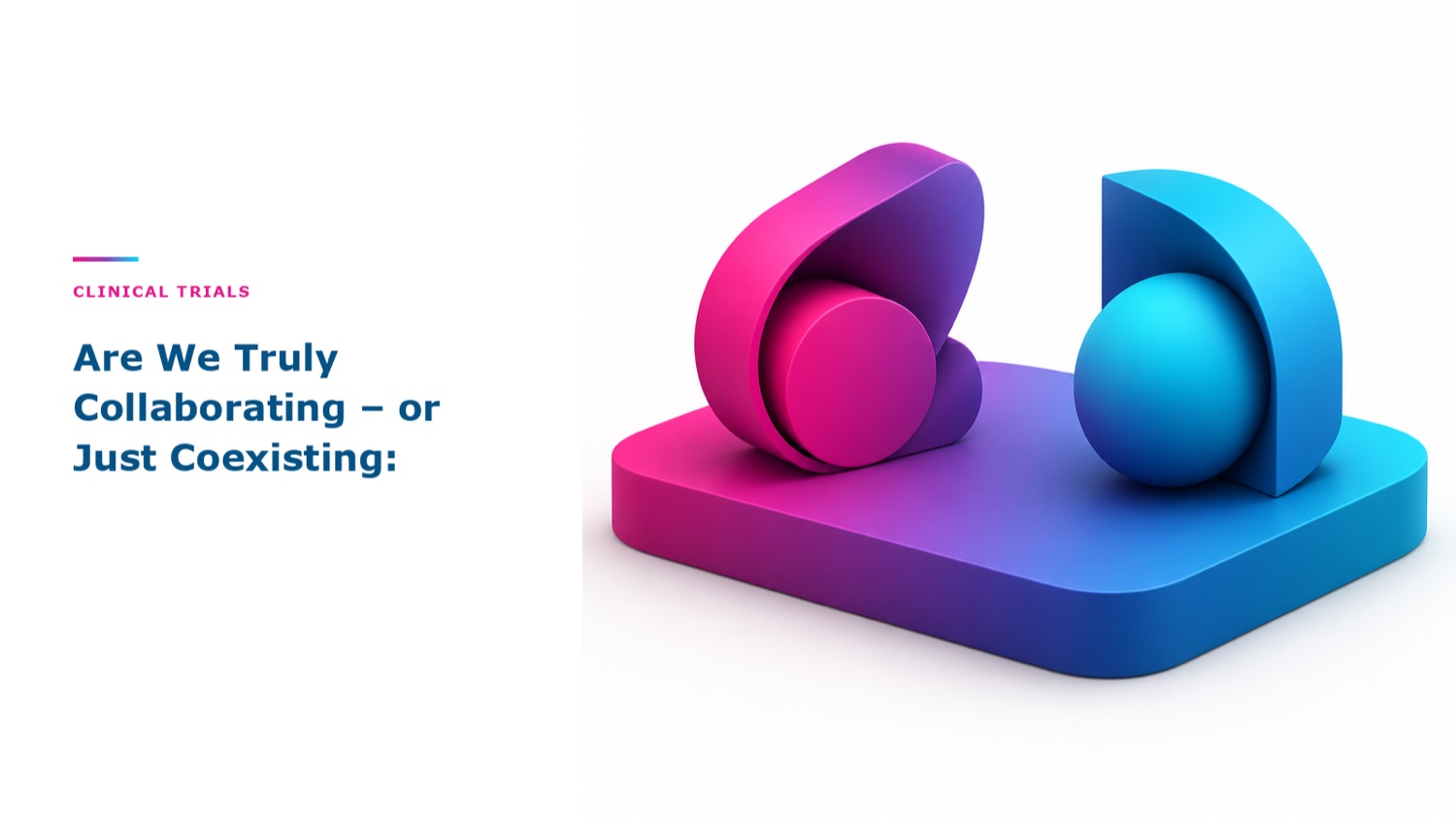
Collaboration in clinical research is a phrase that gets thrown around often. It sounds good. It makes teams feel like they are working together. Too often, though, what we see in practice is coexistence, not collaboration. Research units work side by side, yet their data, decisions, and goals remain disconnected. This is not just an internal problem. It affects participants, delays timelines, and limits what trials can achieve.
True collaboration means more than holding meetings or sharing updates. It means breaking down barriers that keep departments, teams, and external partners from working in lockstep. Without that, we’re not working together. We’re just working near each other.
Breaking Down Clinical Trial Silos
One of the most persistent issues in clinical research is siloed work. Departments often develop their own systems, processes, and priorities. The regulatory team focuses on compliance. Operations manage logistics. Patient engagement teams think about recruitment. When these groups do not talk to each other in real time, they miss critical connections. Recruitment targets may be misaligned with regulatory timelines. Protocol changes might not be shared with patient teams soon enough. Small gaps become major setbacks.
This fragmented approach is called clinical trial silos and presents the following characteristics.
- The Illusion of Teamwork: Many research teams operate under the banner of collaboration, but if you look closely, you often find groups working in parallel, not truly together. We need to ask: are we sharing information effectively, or just occupying the same office space or virtual meetings?
- Communication Breakdowns: Poor communication is a massive barrier. Information gets stuck, messages are unclear, or worse, not shared with everyone who needs to know. This isn’t collaboration; it’s a recipe for errors and inefficiency.
- “Not My Department” Mentality: When team members are overly focused on their specific tasks without seeing the bigger picture, silos form. This “stay in your lane” attitude kills any chance of real teamwork or proactive problem-solving.
These silos do not form on purpose. They come from long-standing organizational habits, legacy systems, and even cultural norms that reward individual team success over shared outcomes. To truly collaborate, those silos need to come down.
The Reality of Research Collaboration Barriers
So, what’s stopping teams from working more closely? It’s not just ego or bad communication. Research collaboration barriers are baked into the structure of how trials are set up.
- Technology Overload or Underuse: We’ve got tools galore, but are they actually helping us work together better, or are they just adding another layer of complexity? Sometimes, having too many disparate systems, or systems that don’t talk to each other, can create more divisions.
- Lack of Shared Goals and Vision: If individuals or sub-teams don’t have a crystal-clear understanding of the overarching objectives and how their part fits in, it’s tough to pull in the same direction. Without a common purpose, true collaboration remains out of reach.
- Fear of Sharing: In some environments, knowledge is treated as power. People might hesitate to share information, data, or insights, fearing they’ll lose their perceived advantage. This directly undermines any collaborative effort.
- Time Pressure vs. True Collaboration: Everyone is under pressure to deliver. Often, taking the time to genuinely collaborate (to discuss, debate, and align) feels like a luxury we cannot afford. So, we take shortcuts, and deep collaboration suffers.
- Leadership Not Walking the Talk: If leaders say they want collaboration but their actions, reward systems, or team structures do not actively support it, then it is just talk. Collaboration needs to be championed and modeled from the top down.
- Differing Priorities and Agendas: Different departments or roles naturally have different priorities. If these aren’t openly discussed and reconciled, teams can end up pulling in opposite directions, despite their best intentions.
The truth is, collaboration takes time, and time is something trials are always short on. There is pressure to hit milestones, secure funding, and publish results. In that race, it can feel easier to stick with the same playbook than to slow down and build new habits. That resistance to change is one of the biggest research collaboration barriers facing the industry today.
Building Habits that Actually Support Teamwork
What’s the real cost of these clinical trial silos? We need to be honest about the impact. Siloed working leads to duplicated effort, missed opportunities, slower progress, and ultimately, can compromise the quality and speed of research outcomes. It’s not just an internal frustration; it has real-world consequences.
Collaboration will not happen just because leadership says it matters. It needs systems that reward cross-functional input and habits that prioritize feedback. For example, a shared platform that allows patient-facing teams to comment on draft protocols in real time can prevent missteps. Including tech and operations leads early in the planning process helps flag potential risks before they grow.
Even simple shifts in meeting formats can help. Bringing together clinical, regulatory, and patient teams for a weekly sync, with a focus on decision-making rather than just updates, can quickly improve alignment. The goal is not to make everyone do everything. It is to make sure the people doing the work understand how it connects to others.
Moving from Coexisting to Collaborating
The first step is admitting there’s a problem. Are we just sharing a postcode, or are we genuinely working as one unit? It’s time for a hard look at how we operate.
It’s not just about how teams work internally. True collaboration also means involving external voices. That includes site staff, vendors, and most importantly, patients. A trial can only be considered collaborative if the people affected by it have had a say in shaping it.
Co-design methods, patient advisory panels, and site feasibility input can all feed into trial design in meaningful ways. These are not just feel-good practices. They lead to clearer protocols, stronger recruitment, and better data. Collaboration with patients can highlight what works in the real world and what does not. Ignoring those insights often leads to costly amendments and delayed enrollment.
Researchers often say they want diverse enrollment. That starts with involving diverse voices early. The more perspectives you build in from the beginning, the fewer barriers you face later.
When collaboration is done right, it shows in every part of the trial’s execution. Teams are aligned. Sites are supported. Participants understand what they are being asked to do before they are asked to do it, and fewer of them leave. See what trialport does for sponsors and CROs.
About the author
Keith Berelowitz has spent more than twenty years watching clinical trials work on paper and struggle in real life. He has helped run studies, advises sponsors and CROs on how they engage with people, and chairs a UK research ethics committee, where consent forms and participant information sheets cross his desk every month. That vantage point led to one conclusion: most trial problems are not failures of science. They are failures of understanding at the moment a person decides.
He founded trialport, a clinical trial navigation and decision-support platform, so that understanding a study comes before anyone is asked to join one. Understanding comes first. Decisions follow.