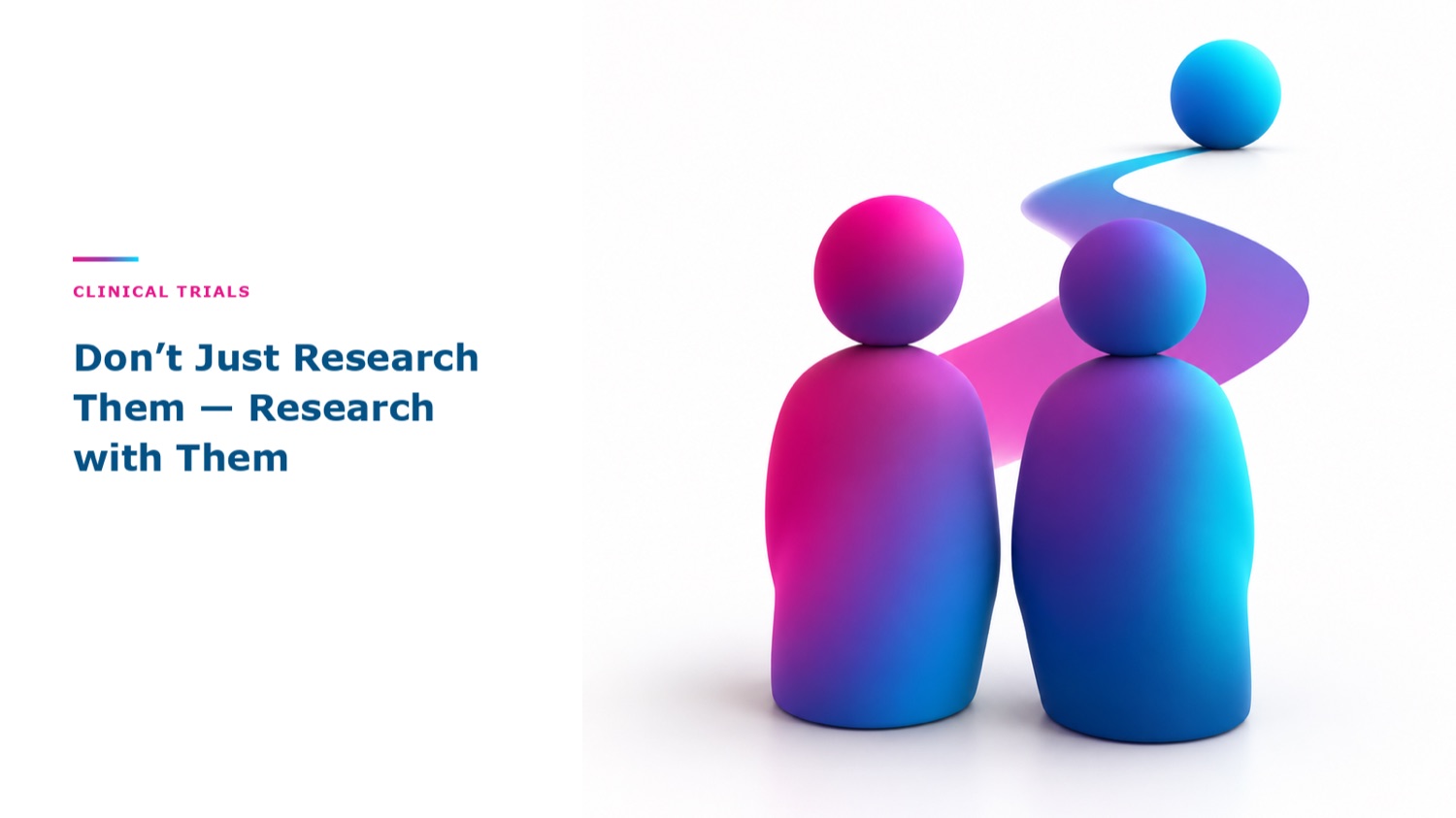
Most people who join a study are still treated as its subjects: recruited, consented, measured, thanked. Yet the people whose lives the research is meant to improve increasingly want, and frankly deserve, to be active partners in how it is designed, run, and shared. It is a change from “doing to” toward “doing with.”
“Nothing About Us Without Us”: This phrase, born from disability advocacy, perfectly captures the sentiment. If research is about improving patient lives, then patients themselves must have a say in how that research is designed, conducted, and shared. It’s common sense, really.
They want to understand what is happening, why it matters, and how they can contribute beyond being a test subject. Clinical trial teams that ignore this shift risk losing relevance, and participants. So the question is not “How can we get patients to join?” It is “How can we invite them in as partners who shape the process from the start?”
Turning Patient Focused Research Into the Standard
Collaboration shouldn’t be a bonus. It should be baked into how we design trials from the ground up. When you invite patients to the table early, you get feedback that helps make studies more accessible, more inclusive, and more likely to succeed.
What does “involvement” actually look like? It is more than just consenting to take part. It means patients contributing to research priorities, helping design study protocols so they are practical, advising on how to communicate information clearly, and even helping to interpret and share the findings. That is the heart of patient focused research. It is about shaping studies around real people, not just the illness they have. It is asking how the trial will affect their daily life, not just whether it fits a scientific protocol.
Patients can point out flaws others miss: maybe the clinic location is too far, maybe the language in the consent form is confusing, or maybe the follow-up expectations are too demanding. These insights do not just improve the participant experience. They help recruitment and retention, too.
Research that bakes in patient perspectives from the beginning is more likely to focus on outcomes that genuinely matter to them. It can also mean trials are designed in ways that are more acceptable and manageable, which can improve recruitment and people sticking with the study. When trials are designed with patients instead of just for them, they become more trustworthy. More ethical. More human.
Listening Before Planning
How to make it happen? Ask them! Don’t assume you know how patients want to be involved. Create genuine opportunities for dialogue. Ask for their ideas, listen to their suggestions, and be prepared to adapt your plans. Genuine involvement isn’t just a token gesture. It requires a real commitment to listen and to act on patient input. It means valuing their lived experience as a crucial form of expertise.
Focus groups, co-design sessions, and advisory panels are powerful ways to bring the patient voice into early conversations. The work does not stop there. True collaboration continues throughout the trial, from recruitment through to post-study follow-up.
Keeping them in the loop builds accountability. When people are part of the process, they naturally have more trust in it. Seeing how decisions are made and having their contributions acknowledged makes the whole endeavor more open. Whether it is through digital platforms, regular check-ins, or direct communication, patients should feel like partners, not passengers, in the research journey. It is a mindset shift: patients are not obstacles to research. They are catalysts.
Clinical Trial Inclusion Starts With Access
If you’re only recruiting from the same cities, the same hospitals, the same demographics, your data won’t reflect the real world. Inclusion is about more than quotas. It’s about meeting people where they are and making it easier for them to say yes.
That is what clinical trial inclusion really means. It is offering flexible visit options, support with transport, or materials in different languages. It is recognizing the barriers that stop people from taking part, and removing them.
Technology can help, but it is not a cure-all. Yes, remote visits and digital diaries can open doors. Do not assume every person has the same level of access or comfort with tech, though. Ask what works for them, and be ready to adapt as needed.
Clinical trial inclusion isn’t about ticking boxes. It’s about building trust with communities that have often been left out or let down. That takes time, humility, and real partnership grounded in listening and learning.
Make science more relatable. Involving patients helps to demystify medical research. When people from the community are part of the research team, it makes the science feel less distant and more connected to real-world concerns.
Trial diversity also improves the science. By including a broader range of people, researchers can detect trends that might otherwise be missed, especially when it comes to how different groups respond to treatment. Inclusion does not just make trials fairer. It makes them smarter, more rigorous, and more useful.
The Power of Co-Creation
When patients help build the trial, they are more likely to believe in it, and when they believe in it, they stick with it. Co-creation does not water down science. It strengthens it by aligning study design with lived realities.
Researchers are experts in science, but patients are experts in what it’s like to live with a particular condition. Combining these two types of expertise can lead to powerful insights and more effective solutions.
Patients can help shape protocols, design communications, and suggest features that make studies less intimidating. They often know what others in their community need or worry about. Ignoring that perspective is a missed opportunity to improve both study quality and patient satisfaction.
In co-creation sessions, researchers get more than feedback. They get allies. Patients become advocates, not just for the trial, but for research in general, creating a ripple effect across communities.
They also bring an eye for details that scientists might overlook: things like readability of instructions, burdens of travel, or concerns around data privacy. When you include patient perspectives early, you reduce the need for mid-study fixes. You get ahead of problems and make the experience better for everyone involved.
Building Respect Into Every Step
It’s not enough to just say patients are partners. You have to show it. That means sharing results, even if they’re not perfect. It means being clear about risks and realistic about benefits. It means following up after the trial ends, and letting people know what their contribution meant to the research.
When patients feel respected, they talk about their experience. They encourage others to join. They are more likely to enroll again in the future and continue supporting the broader goals of clinical research.
Trust is built in small moments: the way a staff member answers a question, the clarity of an explanation, the tone of an email. When trust is broken, it is hard to earn back. When it is maintained, it becomes your most valuable asset in long-term patient engagement.
The benefits outweigh the effort. Yes, meaningful involvement takes time to set up. The payoff (more relevant research, people who stay to the end, increased trust, and ultimately findings that make a bigger difference) is well worth it. It is not just the right thing to do; it is the smart thing to do. See what trialport does for sponsors and CROs, and how it works with communities and advocacy groups.
About the author
Keith Berelowitz has spent more than twenty years watching clinical trials work on paper and struggle in real life. He has helped run studies, advises sponsors and CROs on how they engage with people, and chairs a UK research ethics committee, where consent forms and participant information sheets cross his desk every month. That vantage point led to one conclusion: most trial problems are not failures of science. They are failures of understanding at the moment a person decides.
He founded trialport, a clinical trial navigation and decision-support platform, so that understanding a study comes before anyone is asked to join one. Understanding comes first. Decisions follow.