
Choosing to explore a research study is not a sign that your current treatment has failed. It is a deliberate step toward understanding how new science might align with your personal health goals. Many people living with Immune Thrombocytopenia feel a natural hesitation when they first consider ITP clinical trials. You might worry about fluctuating platelet counts or feel lost in a sea of technical terminology. This sense of uncertainty is a common experience for patients and guardians alike.
This guide helps you understand the landscape of ITP clinical trials so you can make decisions with confidence and clarity. We will explain how different trial phases work and how to identify studies that match your specific medical history. You will learn how a plain-language summary with MedicalFit + Readiness assessments can simplify complex data. trialport provides a supportive framework to help you evaluate research opportunities. Clarity comes first. Decisions follow.
Key Takeaways
- Understand how ITP clinical trials evaluate new strategies for managing platelet counts within a research environment.
- Learn to navigate the progression of trial phases and the ethical standards surrounding the use of placebos.
- Recognize that eligibility requirements are designed to protect your health rather than serve as a personal rejection.
- Evaluate the practical commitments of a study and learn how to discuss these options with your hematologist.
- Utilize the trialport Live Network™ to access a plain-language summary with MedicalFit + Readiness assessments for any study you consider.
Understanding the Landscape of ITP Clinical Trials
Living with a platelet disorder often feels like a constant balancing act. Understanding Immune Thrombocytopenic Purpura (ITP) starts with recognizing it as an autoimmune condition. In this state, the immune system mistakenly identifies platelets as foreign threats and destroys them. This leads to low platelet counts and an increased risk of bruising or bleeding. For many, the first line of care provides stability. For others, standard treatments do not offer the relief they need. This gap in care is why medical research remains vital.
ITP clinical trials represent a significant part of this landscape. These are structured research studies designed to evaluate new ways to manage platelet counts safely. They represent a collaborative journey between the medical community and the people living with the condition. Seeking new options carries significant emotional weight. It’s a choice driven by the desire for better health and a more predictable future. Research is not just about testing a drug. It’s about finding a path to a more stable life.
The Purpose of Research in Platelet Disorders
Current treatments, such as thrombopoietin receptor agonists (TPO-RAs), are effective for many people. However, they don’t work for everyone. Some individuals experience side effects that impact their quality of life. Others find that their bodies eventually stop responding to these therapies. Research aims to find more targeted therapies that address the underlying causes of platelet destruction. The goal is to improve future care for the entire ITP community. Each study contributes to a collective body of knowledge. This knowledge helps scientists refine how they treat this complex disorder. It moves the community toward more personalized care.
Addressing Common Concerns and Anxieties
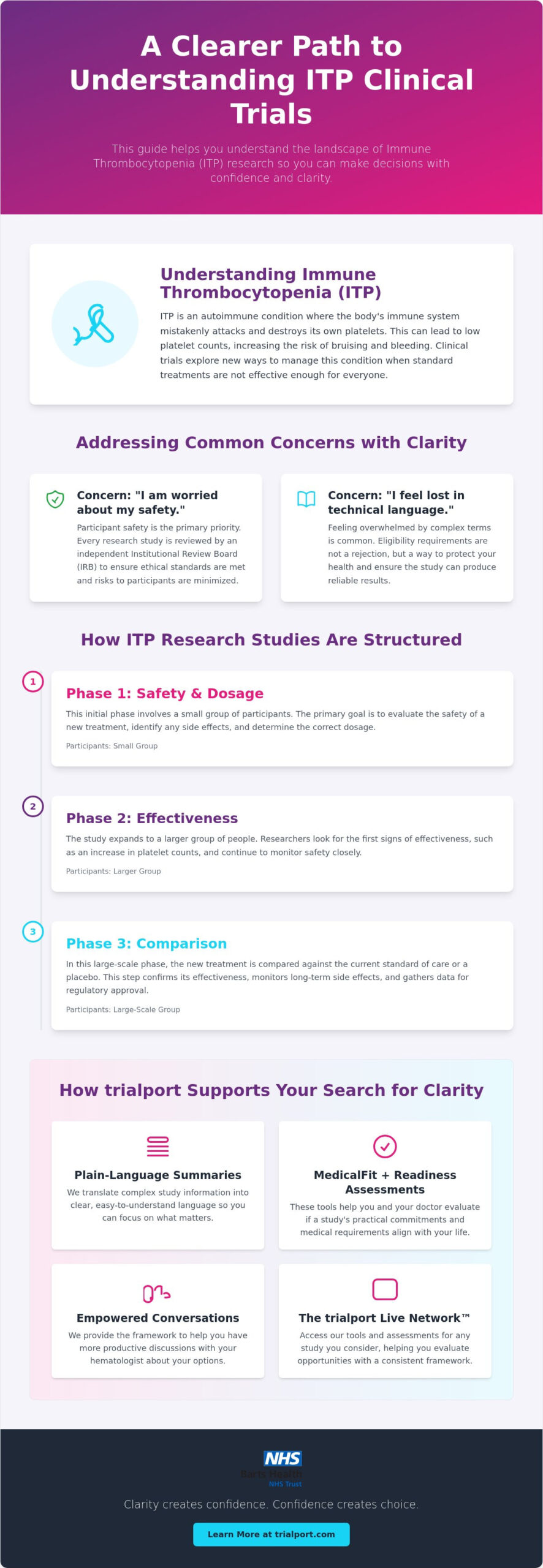
It’s natural to feel anxious when considering a clinical trial. You might worry about your safety or feel like a subject in an experiment. Participant safety is the primary priority of every Institutional Review Board (IRB). These independent committees review every study to ensure ethical standards are met and risks are minimized. trialport helps you understand whether a trial is right for you by providing clear information without the pressure of recruitment. We provide a plain-language summary with MedicalFit + Readiness assessments to help you evaluate your options. We focus on clarity. We do not sell patients. We support science and the people who make it possible. You deserve to feel secure in your choices.
How ITP Research Studies Are Structured
Clinical research follows a specific sequence of steps to ensure that every new treatment is safe and effective. These steps are known as phases. Understanding this structure helps you evaluate the level of evidence currently available for a potential therapy. Many people feel overwhelmed by the technical language used in ITP clinical trials, but the logic behind the process is straightforward. Each phase builds upon the previous one to create a complete picture of how a drug affects the body. This methodical approach is designed to protect participants while gathering the data necessary for regulatory approval.
Transparency is a cornerstone of the modern research ecosystem. It ensures that scientists share their findings openly with the medical community and the public. This open exchange of data helps refine the landscape of ITP clinical trials and allows for more precise treatment strategies. Beyond testing new medications, researchers also conduct observational registries. Unlike interventional trials that test a specific new drug, registries simply observe how people respond to current treatments over time. Both types of studies are essential for improving long-term care and understanding how the disease progresses in different individuals.
Interventional trials are the most common form of ITP clinical trials. They actively test a new medication or procedure to see if it improves health outcomes. These studies are highly controlled to ensure that any changes in platelet counts are actually caused by the treatment being studied. If you are curious about how these study designs might apply to your specific situation, you can reach out to our team for personalized guidance. We focus on providing the clarity you need to make an informed choice at your own pace.
The Phases of Clinical Development
Phase 1 focuses on safety and finding the correct dosage in a small group of participants. Phase 2 looks for the first signs of effectiveness in a larger group to see if the treatment actually increases platelets. Phase 3 compares the new treatment against the current standard of care in a large-scale study. This progression ensures that evidence is gathered methodically before a drug becomes widely available. trialport helps you identify which phase fits your medical history through a plain-language summary with MedicalFit + Readiness assessments.
Placebos and Standard of Care
A placebo is an inactive substance used for comparison in a study. In ITP research, placebos are used ethically alongside rescue medication protocols. These protocols ensure you receive immediate, standard treatment if your platelet counts drop below a safe threshold during the trial. You are never left without a medical safety net. These protections are built into the study design to prioritize your well-being. Understanding these safeguards is a vital part of feeling secure as you explore your research options.
Navigating Eligibility and Suitability for ITP Studies
Every research study operates with a specific set of rules known as eligibility criteria. These are the requirements a person must meet to participate in ITP clinical trials. If you find that you are ineligible for a particular study, try to view this through a different lens. Ineligibility is rarely a personal rejection. It is usually a matter of ensuring your safety or maintaining the precision of the clinical data. Understanding these requirements helps you find a study that aligns with your unique health history.
Decoding Platelet Count Requirements
Researchers often set specific platelet count ranges for entry into a study. For example, a trial might require a count below 30,000 per microliter to ensure the treatment is tested on those who need it most. How ITP research studies are structured often depends on these baseline variables. Your history of prior treatments also plays a significant role. If you have undergone a splenectomy or received rituximab, you may need to wait for a specific period before you can join certain ITP clinical trials. Scientists also look for a state of “stable disease.” This means your platelet counts and symptoms have been consistent enough for a set time to allow for accurate measurement. These rules exist to create a clear and safe environment for every participant.
Using Assessments to Find Clarity
Technical documents and clinical jargon can be difficult to parse when you feel overwhelmed. This is why a plain-language summary with MedicalFit + Readiness assessments is a vital tool for your journey. These assessments help people understand whether a clinical trial is right for them by translating complex criteria into clear information. By using these tools, you activate your own role in the research process. You become a knowledgeable partner in your own care. These assessments are designed for decision support. They do not provide guaranteed enrollment. The final determination always rests with the clinical site and your own medical team. Clarity creates confidence. Confidence creates choice.
Evaluating if an ITP Clinical Trial Is Right for You
Deciding to participate in ITP clinical trials is a choice that extends beyond medical data. It involves your daily schedule, your family, and your long-term health goals. While the science is promising, the logistics of a trial require careful consideration. You should view a research study as a commitment of both time and energy. Some studies may require frequent clinic visits or travel to specialized centers. Evaluating these practical factors is a necessary step in finding a path that fits your life.
Your personal hematologist remains your most important advocate during this process. They understand your medical history in a way that a research team might not yet. Discussing research options with them ensures that any trial you consider aligns with your current treatment plan. This discussion is part of the informed consent process. Informed consent is not a single document you sign and forget. It is an ongoing conversation between you and the research staff. It ensures you always have the information you need to feel secure in your participation.
Mapping out this process helps reduce the feeling of being overwhelmed. You can use our resources for clinical trials for patients to help visualize your journey from initial curiosity to active participation. This tool provides a structured way to look at the road ahead. If you have specific questions about the logistical requirements of a study, contact our team for support. We are here to provide the clarity you need to move forward with confidence.
Practical Questions for Your Care Team
Preparation is the key to a successful experience in a clinical trial. You should ask your care team about the frequency of blood draws and clinic visits. It is also helpful to discuss how a trial might interact with your current medications or your daily lifestyle. You may want to know if the study covers travel costs or provides a long-term plan after the trial period ends. These questions help you build a clear picture of the daily reality of participation. Knowledge replaces uncertainty with a sense of control.
The Power of Informed Choice
Participation is entirely voluntary at every stage. You have the agency to leave a trial at any time, for any reason, without it affecting your standard medical care. This right is a fundamental ethical protection that ensures you remain the primary decision-maker for your health. We operate under the philosophy that this is your journey and your choice. Research should empower you, not pressure you. Clarity creates the space you need to make the best decision for your future.
autoseo-infographic
/autoseo-infographic
How trialport Supports Your Search for Clarity
trialport acts as a clarity and decision-support layer for the ITP community. We recognize that the space between clinical research and your daily life is often filled with noise. Our goal is to quiet that noise. We provide the tools you need to evaluate ITP clinical trials without feeling pressured to act. We believe that a decision is only as good as the understanding that precedes it. By positioning ourselves as an ethical intermediary, we help you find a path that respects your pace and your priorities.
Professional guidance is a vital part of this process. We offer trial navigation services to help you navigate the entire lifecycle of a research study. This service is designed to support your decision making from the moment you first feel curious about a trial until the study concludes. Our navigators are trained to prioritize your understanding over recruitment goals. They act as a bridge, ensuring you have the information necessary to speak confidently with your hematologist and the research staff.
The trialport Live Network™: Connectivity Reimagined
The trialport Live Network™ facilitates real-time connectivity between research sites and participants. This system allows for a steady, transparent flow of information. It helps research sites manage their interactions more effectively by focusing on quality rather than volume. This network streamlines the recruitment process by prioritizing clarity for everyone involved. trialport does not sell patients or traffic. We enable connectivity based on mutual respect and shared knowledge. Sites can better support participants when those participants arrive with a clear understanding of the study requirements.
Your Trusted Guide in Clinical Research
We help you understand if a trial is a fit before you even speak with a research site. This is made possible through a plain-language summary with MedicalFit + Readiness assessments. These tools are designed to lower the temperature of the search process. They help you identify potential obstacles and logistical requirements early on. The trialport Live Network™ also supports biopharma and CROs by ensuring they engage with an informed community. This ethical approach creates a more sustainable research environment for everyone. We remain committed to the idea that your journey belongs to you. Clarity creates confidence. Confidence creates choice.
Moving Toward Informed Choice
Exploring ITP clinical trials is a significant step toward active health management. You now understand how studies are structured and why eligibility criteria exist to protect your safety. You recognize that participation is a logistical commitment that requires open dialogue with your hematologist. This knowledge replaces uncertainty with a sense of calm agency. Clarity is the foundation of this entire process.
trialport supports your journey through professional trial navigation services and the trialport Live Network™. We provide a plain-language summary with MedicalFit + Readiness assessments for every study to help people understand whether a trial is right for them. This real-time connectivity ensures that you have the most accurate information available without the pressure of recruitment. We act as your ethical guide in a complex landscape. We prioritize your understanding at every stage.
Understanding comes first. Decisions follow. Explore ITP trial navigation with trialport. Clarity creates confidence. Confidence creates choice.
Frequently Asked Questions
What is ITP and how do clinical trials help?
Immune Thrombocytopenia is an autoimmune condition where the immune system destroys platelets. This leads to a higher risk of bleeding and bruising. Clinical trials evaluate new therapies designed to stabilize platelet counts and improve quality of life. These studies offer a path to treatments that are not yet available to the general public.
Will I receive a placebo in an ITP trial?
Some studies use a placebo to compare the effectiveness of a new treatment. However, you are never left without a safety net. Researchers use rescue medication protocols to provide immediate care if your platelet counts drop too low. Your health and safety remain the primary priority throughout the entire research process.
What is a plain-language summary with MedicalFit + Readiness assessments?
This is a decision-support tool that translates complex clinical data into accessible information. It helps you understand the logistical and medical requirements of a study before you commit to a site visit. These assessments activate your role as an informed participant. They help you determine if a study aligns with your personal health goals.
Can I participate in a trial if I have had a splenectomy?
Many research studies accept participants who have undergone a splenectomy. Each study has specific eligibility criteria that may require a certain amount of time to pass after your surgery. Reviewing a plain-language summary with MedicalFit + Readiness assessments can help you understand how your surgical history affects your suitability for ITP clinical trials.
What happens if my platelet count drops during the study?
Every study includes a safety protocol to manage sudden drops in platelet counts. Researchers monitor your health closely and provide standard treatments or rescue therapies if your counts fall below a safe threshold. This ensures you receive the necessary care while participating in research. Participant safety is the most important factor in every clinical study.
How does the trialport Live Network™ help me find a trial?
The trialport Live Network™ connects you with research sites in real-time to provide the most current study information. It simplifies the search for ITP clinical trials by offering a direct link between the research community and people seeking new options. This connectivity focuses on clarity and transparency. It helps you find relevant research without the pressure of typical recruitment services.
Is there a cost to participate in an ITP clinical trial?
Most interventional studies provide the investigational treatment and all related medical tests at no cost to the participant. Some trials also offer reimbursement for travel or other logistical expenses. You should discuss the specific financial details with the research team during the informed consent process. This ensures you have a clear picture of the commitment before you begin.
Can I leave a clinical trial after it has already started?
You have the right to withdraw from a study at any time for any reason. Participation is entirely voluntary. Leaving a trial will not affect your standard medical care or your relationship with your hematologist. This protection ensures that you remain in control of your own health journey. Clarity creates confidence. Confidence creates choice.