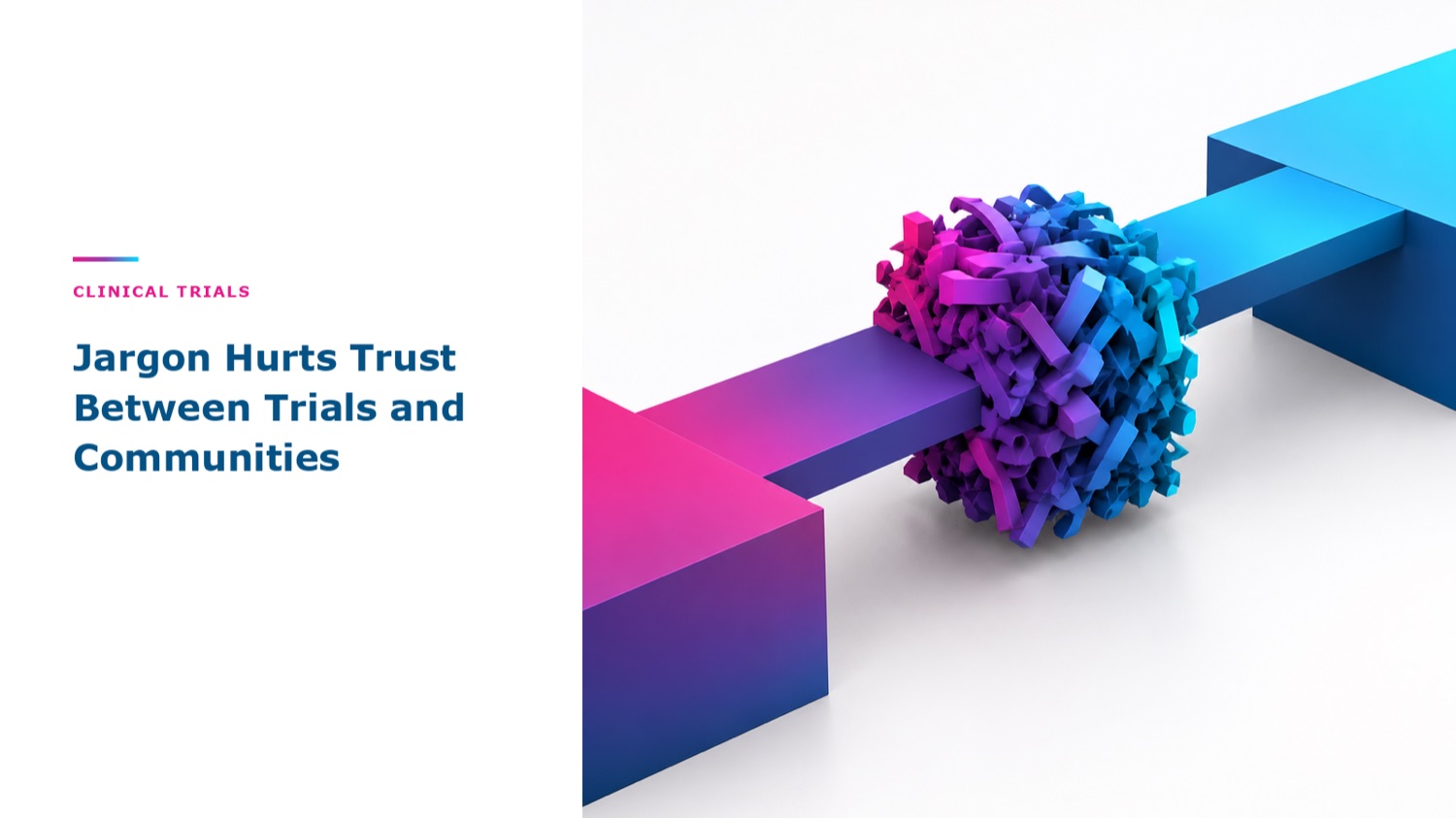
A clinician says “your tumor is progressing” and means bad news. One person in five hears something else. That gap is the subject of a cross-sectional survey run by the University of Minnesota at the 2021 Minnesota State Fair near St. Paul, Minnesota, USA, testing how well people understand common medical jargon. 215 volunteers completed the survey (116 written, 99 verbal). Respondents had a mean (SD) age of 42 (17) years, 140 (65%) had a bachelor’s degree or higher, and 135 (63%) were female. All respondents completed the entire survey, demographics were statistically similar across the survey type, and since there was no significant difference in correct understanding between written and verbal surveys for all but 2 questions, the responses are grouped together for the remainder of the analysis.
There was mixed understanding of which phrases were meant to convey good news vs bad news. 207 respondents (96%) knew that negative cancer screening results meant they did not have cancer. However, 170 respondents (79%) knew that “your tumor is progressing” was bad news, and 143 knew that positive nodes meant their cancer had spread (67%). Only 89 (41%) correctly interpreted “neuro exam is grossly intact” as good news. While 127 respondents (80%) recognized that an unremarkable chest radiography was good news, only 44 (21%) correctly understood that a clinician saying their radiography was impressive was generally bad news. Few respondents accurately understood the prompts that required a free-text response. Sixty-two respondents (29%) correctly interpreted “bugs in the urine” as intending to convey a urinary tract infection, 20 (9%) knew what febrile meant, and 4 (2%) understood the phrase occult infection.
Significantly more respondents correctly interpreted the phrase nothing by mouth compared with the use of the acronym NPO (162 [75%] vs 24 [11%]). When comparing the understanding of blood infection through non jargon (“blood test shows no infection”) vs jargon (“your blood culture was negative”), significantly more respondents correctly interpreted the non jargon phrase than the jargon phrase (208 [98%] vs 186[87%]).
In multivariable logistic regression models, there were a few statistically significant associations between demographics and understanding. Notably, increasing age was associated with increased understanding of nothing by mouth and negative blood cultures but decreased understanding of the term impressive in the context of radiography findings. Two questions showed an association with increased understanding if the respondent had a graduate degree: the phrases nothing by mouth and unremarkable, and the acronym NPO and the term febrile were better understood by women.
The researchers’ testing of several phrases that had been studied previously yielded several notable differences, in most cases with a higher proportion of their sample demonstrating understanding. In 2001, Chapman et al found that among a sample of 105 adults in the UK, only 52% understood that the phrase “the tumor was progressing” signified bad news. They noted that progress is interpreted as a good thing in most settings. In the Minnesota study, 79% of respondents correctly understood this phrase as bad news. 43% of the respondents in the Chapman et al study correctly understood that having positive nodes meant their cancer had spread vs 67% correct among the Minnesota sample.
Some of these differences may be accounted for by cultural differences between the UK-based sample in the Chapman study and the US sample. The high number of college graduates in the Minnesota sample (65% with a bachelor’s degree or higher) compared with the general population of the United States (35%) may also be a factor, although Chapman et al also reported that “a large proportion of the sample was well educated.” It should be noted that the researchers found no statistically significant association between level of education and accuracy in interpreting the jargon for all but 2 survey questions, so this is unlikely to account for the differences fully.
Some changes in understanding may be the result of the COVID-19 pandemic. The authors hypothesize that the widely used designations of negative and positive in the context of viral testing during the pandemic have increased the public’s understanding of these terms in the medical context, accounting for the near-universal understanding of negative cancer screening being considered good news. However, it is worth noting that when comparing the understanding of the phrase “your blood test shows no infection” and “your blood culture was negative,” significantly more respondents correctly interpreted the phrase that avoided the word negative altogether.
The use of terms that mean something different in common usage than in a medical context was a frequent cause of confusion in the study. More people believed that the phrase “an occult infection” had something to do with a curse rather than a hidden infection. Fewer than half knew that their neuro examination being “grossly intact” was a good thing, possibly because the word “gross” more often means “unpleasant” in common usage. Clinicians may not recognize these terms as jargon because they are not categorized as technical, medical terminology, but they have been shown to be used frequently in clinical settings.
Given that increasing age comes with more opportunities to have heard these terms used in a medical context, it is somewhat surprising that older age was only associated with better understanding of 2 of the 13 phrases. The lack of consistent predictors of understanding by the demographics studied (age, gender, and education) highlights the importance of using clear communication with all patients. It is also worth noting that while nothing by mouth was better understood than NPO by nearly 7-fold, 1 in 4 respondents also did not understand the phrase nothing by mouth. Given that in everyday language we do not talk about the act of eating or drinking as taking something by mouth, perhaps the clearest way to indicate that a patient should abstain from oral intake is to simply say, “You should not have anything to eat or drink.”
Why Trial Jargon Pushes Patients Away
Clinical trials depend on people taking part, but trial jargon builds walls instead of trust. Terms like “randomization,” “placebo-controlled,” and “protocol deviation” confuse participants, making them feel excluded from their own healthcare decisions. People who do not understand the language feel lost, uncertain, and shut out.
This confusion isn’t harmless. It damages recruitment, increases dropout rates, and reduces adherence. A patient unsure about what’s being asked of them is less likely to consent. If they do join, misunderstandings about the trial process can lead to early withdrawal. Patient trust is fragile, and unnecessary complexity only makes it weaker.
Bridging the gap starts with language. Plain, accessible explanations give people confidence. They should know exactly what is happening at every stage. By removing jargon, research teams build partnerships instead of barriers. This shift does not just improve retention. It strengthens public perception of clinical trials, making future recruitment easier.
The Hidden Costs of Confusion
Trust is hard to build and easy to lose. A lack of clarity fuels suspicion, particularly among communities with historical reasons to distrust medical research. If people feel like they are being misled, or simply do not understand what they are signing up for, they will walk away.
This loss of trust doesn’t just affect one trial. Negative experiences spread quickly through word of mouth, deterring others from participating. A single instance of unclear communication can ripple through a community, making recruitment for future studies even harder.
Patients who do stay enrolled may not fully grasp key elements of their care. Confusion around dosages, procedures, or potential side effects can lead to errors, putting participants at risk and compromising data integrity. When the research team assumes patients understand but never actually checks, mistakes become inevitable.
Addressing this issue requires more than simplified consent forms. Real understanding happens through ongoing conversations, where people feel comfortable asking questions. If a term is not commonly used outside the industry, it should not be used without explanation. Research teams must remember that technical accuracy does not matter if the person does not understand what is being said.
Patient Trust Begins with Clarity
Transparency is the foundation of trust. When people feel informed and respected, they are more likely to commit to a trial and follow through with the required steps. Trust is not built through words alone, though. It is about how information is delivered.
Patients need information that is plain and direct, with no unnecessary technical terms. It must be relevant, focused on what participants need to know, and presented in a conversational way that feels natural rather than scripted.
The issue extends beyond consent forms. Patient education materials, pre-screening conversations, and investigator meetings all play a role in shaping perceptions. If people hear a jumble of technical terms at every touchpoint, they are more likely to switch off. If communication is clear and tailored to their needs, they feel confident rather than overwhelmed.
This approach is especially important in diverse communities where language barriers add another layer of complexity. Providing clear, translated materials in addition to verbal explanations helps bridge the gap. Making an effort to listen and adapt to different patient needs shows respect and reinforces trust.
Communities with historically low participation rates in clinical trials often cite poor communication as a key reason for hesitation. Many have experienced a lack of transparency in healthcare settings before, making them cautious about new medical interventions. By prioritizing clarity, researchers can show that trials are not something done to people but something done with them.
Trial Jargon Creates an Unequal Playing Field
Trial jargon does not just confuse people. It creates a power imbalance. When one side of a conversation understands the terms and the other does not, it reinforces the idea that researchers hold all the authority. Participants may feel pressured to agree to things they do not fully understand, leading to ethical concerns about informed consent.
Informed consent should be exactly that: informed. This means making sure people grasp what is being communicated, not just signing a document because they feel they have to. The language used in trials should give participants confidence in their choices.
There is also a practical impact. People who do not understand instructions may struggle to follow treatment protocols correctly. Miscommunication increases the risk of errors, affecting trial results and participant safety. Research teams must take responsibility for clarity. If a participant does not understand something, it is the trial team’s fault, not the participant’s.
The problem isn’t limited to patients. Family members and caregivers who support trial participants often need to understand key trial details, too. If communication is overly technical, these support networks may struggle to provide the help that patients need. That can lead to missed appointments, incorrect medication adherence, and unnecessary stress for participants.
Making information accessible is not a legal box to tick. It is a commitment to ethical research. People deserve clear, honest communication. They are not test subjects; they are partners in the advancement of medicine.
How Research Teams Can Build Better Relationships
Shifting from jargon-heavy communication to patient-friendly language doesn’t require a complete overhaul. Small, practical changes make a big difference.
Testing readability ensures that information makes sense to non-experts. If something wouldn’t be easily understood by someone outside the field, it should be rewritten. Using analogies helps connect medical concepts to familiar experiences, making them easier to grasp. Checking for understanding instead of assuming clarity ensures that patients are truly informed. Encouraging questions reassures patients that no query is too basic and that their concerns are valued.
It is also important to involve people in shaping communication strategies. Working with patient advocacy groups, community leaders, and previous trial participants can help research teams understand what works and what does not. People who have been through the process before can offer valuable insights into where language fails and what changes would make the experience more accessible.
Another useful approach is the teach-back method. This involves asking people to explain key trial details in their own words. If they struggle, it is a sign that the explanation needs to be simplified. This is not about testing anyone. It is about making sure communication is effective.
Building trust is not about dumbing things down. It is about making sure people have the information they need to make informed decisions. People want to be involved in their care, and they need the right tools to do so.
Every study on trialport is presented as a plain-language summary with medifit™ + readifit™ self-reflection tools, so the first thing a person reads about your study is something they can understand. See what trialport does for sponsors and CROs.
About the author
Keith Berelowitz has spent more than twenty years watching clinical trials work on paper and struggle in real life. He has helped run studies, advises sponsors and CROs on how they engage with people, and chairs a UK research ethics committee, where consent forms and participant information sheets cross his desk every month. That vantage point led to one conclusion: most trial problems are not failures of science. They are failures of understanding at the moment a person decides.
He founded trialport, a clinical trial navigation and decision-support platform, so that understanding a study comes before anyone is asked to join one. Understanding comes first. Decisions follow.