
It takes an average of six to ten years for a person to receive a von Willebrand disease diagnosis after their symptoms first appear. This long wait often leaves patients and families feeling exhausted by the time they start exploring long-term management options. When you begin looking into von Willebrand disease clinical trials, that exhaustion can quickly turn into confusion. You might feel uncertain about the safety of new therapies or struggle to find a study that matches your specific VWD type.
You deserve a path that prioritizes your understanding before you are asked to make a choice. This article explains how to evaluate current research opportunities with clarity and confidence. We will examine the different phases of research, the latest subcutaneous therapy developments like VGA039, and how to access supportive navigation services. You will learn how trialport uses a plain-language summary with MedicalFit + Readiness assessments to help you determine if a specific trial aligns with your health goals. Clarity creates confidence. Confidence creates choice.
Key Takeaways
- Learn how clinical research aims to expand management options for the different types of von Willebrand disease.
- Understand the differences between interventional trials for new therapies and observational studies that monitor the condition over time.
- Discover how to navigate von Willebrand disease clinical trials by focusing on your unique medical needs and personal preferences.
- Gain insight into the screening process to ensure you feel secure and informed throughout every stage of the research journey.
- Explore how trialport uses a plain-language summary with MedicalFit + Readiness assessments to support your ability to make independent choices.
Understanding von Willebrand disease and the role of clinical research
Living with a chronic bleeding disorder requires a steady foundation of knowledge. Von Willebrand disease is a condition that affects how your blood clots. It is not just about heavy periods or frequent nosebleeds. It is a life-long journey that involves managing a specific, vital protein in your bloodstream. When you understand how this protein behaves, you can better evaluate how von Willebrand disease clinical trials aim to improve your quality of life.
What is von Willebrand disease (VWD)?
VWD is caused by a deficiency or a malfunction in the von Willebrand Factor, often abbreviated as VWF. This protein acts as a biological glue. It helps platelets clump together to form a plug at the site of a blood vessel injury. If your body does not have enough functional VWF, your blood cannot clot properly. This leads to prolonged bleeding after an injury or surgery. You can find a detailed overview of the various classifications and causes by Understanding von Willebrand Disease through established medical resources.
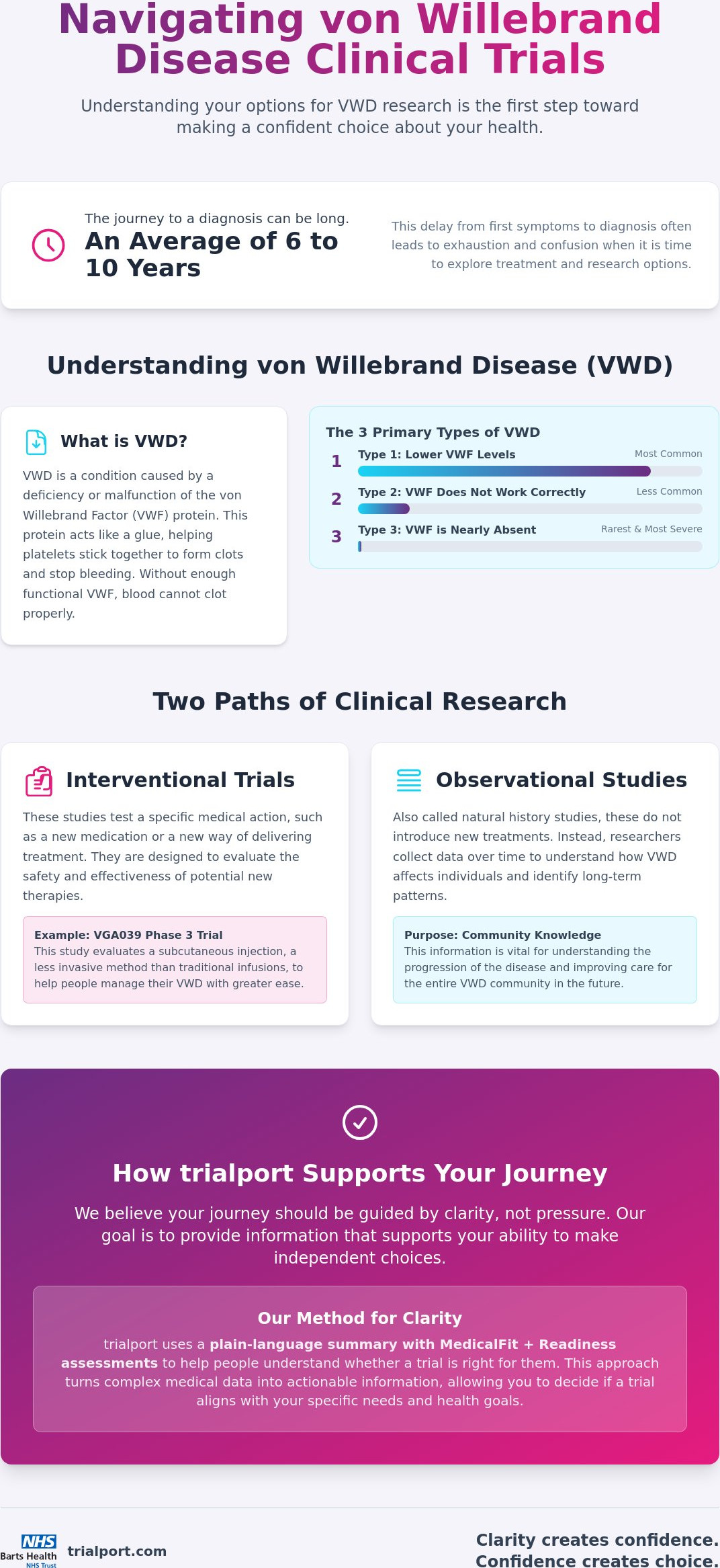
The condition is categorized into three primary types. Type 1 is the most common and generally results in lower levels of VWF. Type 2 involves VWF that does not work correctly. Type 3 is the rarest and most severe form, where VWF is almost entirely absent. Clinical research is often specific to these types. A trial might focus on a new subcutaneous injection for Type 3, while another study might look at better prophylactic options for Type 1. This specificity ensures that research addresses the unique needs of every individual.
Why clinical trials are necessary for VWD care
Current treatments have provided a baseline of safety for many years. However, scientific progress depends on the constant search for better management options. Research helps identify ways to manage bleeding episodes with fewer side effects. It also allows for the study of the long-term safety of therapies that could become the future standard of care. This work is only possible through a dedicated partnership between researchers and the VWD community.
Choosing to participate in research is a personal step toward gaining agency over your health. It allows you to explore potential therapies while contributing to a larger pool of community knowledge. At trialport, we believe that your journey should be guided by clarity rather than pressure. We provide a plain-language summary with MedicalFit + Readiness assessments to help people understand whether a trial is right for them. This approach turns complex medical data into actionable information, allowing you to decide if a trial fits your specific needs.
The landscape of von Willebrand disease clinical trials has evolved into a diverse ecosystem of research opportunities in 2026. Understanding the different types of studies helps you see where your participation might align with your personal health goals. Research is generally divided into two distinct categories. These are interventional trials and observational studies. Each serves a unique role in advancing medical science and improving community outcomes.
Interventional trials for new treatments
Interventional trials are designed to test a specific medical action or therapy. This often involves a new drug or a different way of delivering an existing treatment. In 2026, a major trend in research is the move toward subcutaneous injections. These are treatments administered just under the skin. They are often less invasive than traditional intravenous infusions. For example, the Phase 3 trial for VGA039 is currently evaluating this delivery method to help people manage their condition with greater ease.
Phase 3 trials represent a critical milestone in the research process. They focus on confirming the effectiveness and safety of a potential therapy in a large and diverse group of participants. This phase is often the final step before a treatment is submitted for regulatory approval. You can use official databases to Find VWD Clinical Trials that match your specific diagnosis and location. These trials offer a way to explore emerging therapies under close medical supervision.
Natural history and observational studies
Not every study involves a change to your medication. Observational studies, which are often called natural history studies, follow the progression of the disease over a long period. They do not introduce new treatments. Instead, they collect data on how VWD affects individuals throughout their lives. This information is vital for understanding biologic risks and identifying long-term patterns in bleeding episodes.
These studies are especially important for rare forms of the condition, such as Type 3 or Type 2N. By tracking the health of many individuals, researchers can identify unmet needs that interventional trials should address next. If you are interested in contributing to scientific knowledge without changing your current care plan, an observational study might be the right fit. If you have questions about which path to take, you can contact us to discuss your options. We provide a plain-language summary with MedicalFit + Readiness assessments
Evaluating whether a clinical trial is the right choice for you
Finding a list of von Willebrand disease clinical trials is only the first step. The real challenge lies in determining if a specific study fits your life and your health. This is a personal journey that requires both time and space. You should never feel rushed to make a medical decision. Clarity is the foundation of every high-quality choice you make for your care.
Assessing personal readiness and medical fit
Medical fit is the alignment between trial requirements and patient health. This involves checking if your specific VWD type and history match the study criteria. For example, some research at the Mayo Clinic may only be open to adults with Type 3 VWD. This ensures the safety of the participants and the accuracy of the data collected during the study.
Personal readiness is equally vital. It involves your emotional and logistical ability to participate in a study. You should consider whether you can commit to the scheduled clinic visits and if you have reliable transportation. Readiness also means having the emotional space to focus on the requirements of the trial. Discussing these factors with your family and healthcare team helps you see the full picture of what participation requires before you commit.
The importance of plain-language summaries
Clinical protocols are often written in dense, technical language. This can lead to anxiety or misunderstanding for patients and their guardians. Plain-language summaries remove technical jargon to ensure clear understanding. When you are reviewing von Willebrand disease clinical trials, you should have access to information that is easy to digest. This approach prioritizes your agency and your partnership with the research site.
At trialport, we provide a plain-language summary with MedicalFit + Readiness assessments to help people understand whether a trial is right for them. These tools help you evaluate a trial objectively without the pressure of recruitment. Clarity improves decision quality. When you understand the reasons behind a trial, you can move forward with a sense of calm. Clarity creates confidence. Confidence creates choice.
The journey of participating in a VWD clinical trial
The transition from considering a trial to actually participating in von Willebrand disease clinical trials is a methodical process. It begins with identifying a study that aligns with your medical history and your specific type of von Willebrand disease. This phase is about finding a match that feels right for both your body and your lifestyle. Professional navigation ensures you are supported at every milestone so you do not feel overwhelmed by the complexity of the research system.
Finding and screening for suitable trials
You can begin your search by exploring available clinical trials for patients through our platform. Once you find a study that interests you, the screening process begins. Screening is a collaborative effort between you and the clinical research site. It involves a series of medical tests to verify your eligibility for the study. These tests may include blood draws to measure your current clotting factor levels or physical examinations to establish a health baseline.
The screening process is designed primarily to protect participant safety. It ensures that the trial requirements will not pose an unnecessary risk to your health. If the medical tests show that a trial is not a safe fit, the research team will explain the reasons clearly. This process provides an extra layer of medical oversight before any new therapy is introduced. It is a vital step in ensuring that research is conducted with the highest ethical standards.
The informed consent process
Participating in research requires a clear understanding of informed consent. This is the process where you receive a full explanation of the risks, benefits, and requirements of the study. Informed consent is a continuous dialogue rather than a single signature on a document. You should always feel encouraged to ask questions until you have complete clarity on the process. The research team acts as a partner in this conversation, providing the information you need to maintain your agency.
One of the most important aspects of informed consent is the freedom to change your mind. You can leave a trial at any time for any reason. This right is protected by law and ethical guidelines. Informed consent serves as a bridge between the research site and the participant. It establishes a relationship built on transparency and mutual respect. If you are ready to begin this journey, you can contact us to learn more about how we support your decision making process through a plain-language summary with MedicalFit + Readiness assessments.
autoseo-infographic
/autoseo-infographic
How trialport supports your VWD research journey
trialport acts as a knowledgeable mentor to help you manage the complexities of medical research. We understand that exploring von Willebrand disease clinical trials can feel overwhelming. Our primary goal is to help people understand whether a trial is right for them. We do this by providing a layer of clarity that sits between you and the clinical research site. This ensures that you have the space to make a deliberate choice at your own pace.
Trial navigation: expert guidance for patients
Families often experience anxiety when they first encounter the clinical trial system. Our clinical trial navigation services are designed to lower the temperature of this experience. We act as a protective intermediary that prioritizes ethical engagement and mutual respect. This service guides you through the trial lifecycle with integrity. You are never pressured to act. Instead, you are supported as you gain the knowledge necessary to feel secure in your path.
Professional navigation involves more than just finding a study. It includes understanding the practical impact of participation on your daily life. We help you evaluate the logistics of clinic visits and the specifics of the trial protocol. This human-centric approach ensures that the dignity of the individual is always maintained. By focusing on your unique perspective, we help transform uncertainty into a sense of calm confidence.
The trialport Live Network™: connecting the ecosystem
The process of understanding patient recruitment for clinical trials often focuses on numbers and speed. The trialport Live Network™ takes a different approach by facilitating real-time connectivity between research sites and communities. This network improves communication between sponsors and the people who may benefit from their work. It creates a transparent environment where information flows freely without the pressure of traditional recruitment methods.
We want to be clear that trialport is a clarity layer rather than a lead-generation service. We do not sell patients or focus on short-term gains. Our network is built on long-term trust and the belief that informed decision-making is the only ethical path forward. We use a plain-language summary with MedicalFit + Readiness assessments to provide an objective view of every opportunity. This ensures that the transition from learning to acting is entirely driven by your own needs.
Understanding comes first. Decisions follow.
Creating a Path of Clarity and Choice
Navigating von Willebrand disease clinical trials requires a balance of scientific information and personal reflection. You have seen how research has evolved to include subcutaneous therapies and long-term observational studies. You also understand that your participation is a choice that depends entirely on your medical fit and readiness. This journey is not one you have to take alone. It is a collaborative process that respects your pace and your priorities.
trialport provides the support you need to evaluate these opportunities without feeling rushed. We offer professional trial navigation services and the real-time connectivity of the trialport Live Network™. Every step of our process is anchored by a plain-language summary with MedicalFit + Readiness assessments. These tools are designed to support decision making by turning complex protocols into clear, actionable insights for you and your family. We believe that a well-informed patient is an empowered partner in the research ecosystem.
Understanding comes first. Decisions follow. Explore clinical trials for patients to begin your journey toward clarity. Clarity creates confidence. Confidence creates choice.
Frequently Asked Questions
Can I participate in a VWD clinical trial if I am already on treatment?
Many trials allow participants who are currently receiving treatment, though specific eligibility criteria will always apply. Some studies require a washout period, which is a set time where a participant stops their current medication to ensure it does not interfere with the study results. You should review the protocol details with your doctor to see how your current management plan aligns with the requirements of the research.
Is there a cost associated with joining a von Willebrand disease clinical trial?
Most clinical trials do not require participants to pay for the study treatment, medical tests, or clinic visits. The study sponsor typically covers these expenses as part of the research budget. Some trials also provide reimbursement for travel, parking, or lodging costs to reduce the burden on your family. You should ask the research team for a clear breakdown of covered expenses before you agree to participate.
How much time should I expect to commit to a VWD research study?
The time commitment for a research study depends on the specific protocol and the type of von Willebrand disease clinical trials you choose. Interventional studies may require monthly clinic visits for monitoring or infusions. Observational studies often involve fewer visits and may only require you to submit health data periodically. Reviewing the schedule of events in the study protocol will help you understand the logistical impact on your daily life.
What happens if I decide to leave a clinical trial before it ends?
You can leave a clinical trial at any time without any negative consequences for your future medical care. Your right to withdraw is protected by ethical guidelines and is a fundamental part of the informed consent process. It is helpful to notify the research team of your decision so they can conduct a final safety check. This ensures that you transition back to your standard care plan smoothly and safely.
Can children with von Willebrand disease participate in clinical research?
Children can participate in clinical research that is specifically designed for pediatric populations. For example, Vonvendi received expanded FDA approval for pediatric use in September 2025 following dedicated research. Children must have the permission of a parent or guardian to join a study. In many cases, older children are also asked to provide their assent, which is their personal agreement to participate alongside their guardian’s consent.
How is my private health information protected during a trial?
Your private health information is protected by federal laws and rigorous institutional security protocols. Research sites use de-identification, which is the process of removing your name and personal details from the data shared with sponsors. Only authorized members of the research team have access to your full medical record. These safeguards are designed to maintain your confidentiality while allowing scientists to analyze the results of the study accurately.
What is the difference between a phase 2 and a phase 3 VWD trial?
Phase 2 trials evaluate the safety and dosage of a treatment, while Phase 3 von Willebrand disease clinical trials confirm its effectiveness in a larger population. Phase 2 studies involve a smaller group of people to identify early signs of benefit. Phase 3 trials are typically the final requirement for a treatment to be approved by regulatory agencies. This phase provides the robust data needed to ensure a therapy is safe for the general public.
How do I know if a trialport plain-language summary is available for a specific trial?
You can check the trialport platform to see which studies include our decision support tools. If a trial is part of our network, you will find a plain-language summary with MedicalFit + Readiness assessments attached to the study description. This tool helps you evaluate the requirements of the research objectively. If you do not see a summary for a specific trial, you can contact us to request more information about available resources.
Understanding comes first. Decisions follow.