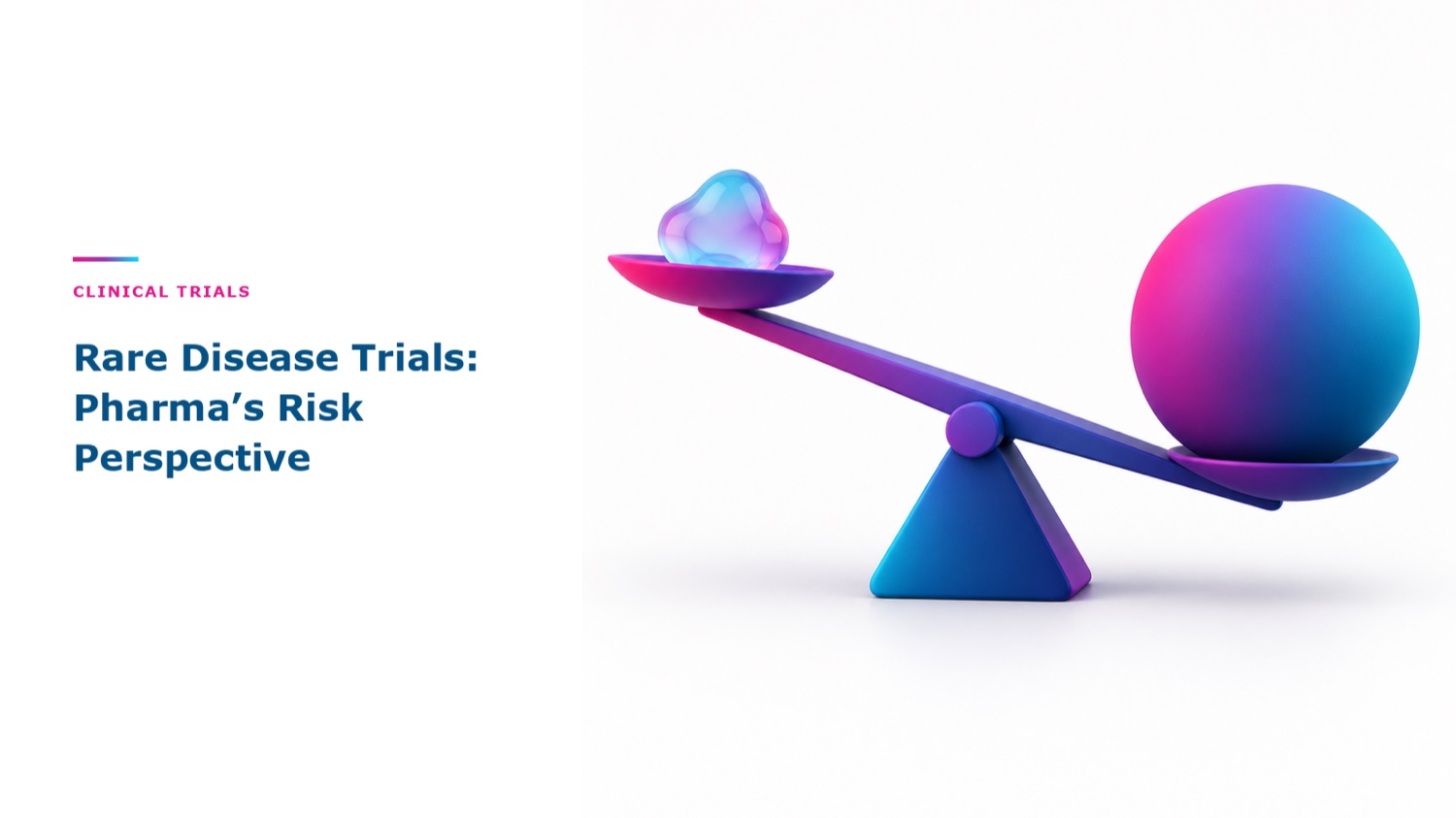
Rare disease clinical trials push the limits of traditional research. With small and scattered patient populations, evolving regulatory expectations, and high development costs, they carry risks that most pharma companies cannot afford to ignore. Yet the same conditions that make these trials hard also make them matter: unmet need, room to innovate, and the chance to make a lasting difference. Understanding how pharma sees that risk is essential to running these studies well.
In traditional trials, risk is spread over large, relatively predictable populations. In rare disease clinical trials, every element carries heightened stakes. Enrollment is a slow, fragile process. Dropout rates hit harder, and delays can sink an entire study. The combination of scientific uncertainty and business risk demands a different kind of planning.
The financial pressure is immense. Rare disease trials are expensive, with no guarantee of market access at the end. A single failed trial could jeopardize a company’s entire rare disease portfolio. That is why risk mitigation is not just part of the process: it drives the process. From early feasibility to post-market surveillance, each phase must be carefully built to manage risk while still meeting regulatory and patient expectations.
Companies that excel in this space take bold steps early. They invest in patient mapping and epidemiology before even designing protocols. They build out community engagement strategies in parallel with site selection. It’s about reducing the unknown. Rare disease clinical trials force pharma to shift from reactive to proactive, leaning into patient input and adaptive design to stay on course.
Understanding Pharma Trial Risks
Pharma trial risks in rare diseases begin with the unknown. Many of these conditions are poorly understood, with few natural history studies and limited diagnostic pathways. Without this data, designing a robust, reproducible trial becomes a guessing game.
Recruitment risks are especially sharp. You cannot just open sites and hope for patients to show up. People may be scattered across geographies, and some might not even know they have the condition. Misdiagnosis and diagnostic delay are built-in barriers. That means successful trials often require diagnostic support programs, remote site access, or even direct-to-patient models.
Retention is another problem. The burden of participation in a rare disease trial can be high: frequent travel, long visits, invasive procedures, or complex regimens. The stakes are personal, too. These are often pediatric trials or involve degenerative conditions, where families are weighing participation against already overwhelming health challenges. Eligibility is not readiness. A family can meet every criterion and still be unable to sustain the schedule, and if the trial is not designed around the realities of their lives, they may leave.
Regulatory risk is also higher. There is increasing pressure to provide meaningful data on smaller cohorts, which raises the bar for data quality and endpoint selection. Agencies like the FDA, MHRA and EMA have become more open to adaptive designs, real-world evidence, and surrogate endpoints, but only when the rationale is strong and the data supports it.
Then comes commercial uncertainty. Even if a treatment proves successful, reimbursement pathways remain complex. Pricing a rare disease drug is delicate, and access can be blocked by payers unsure of long-term value or data generalizability.
Making Data Work Harder
To manage these risks, companies are rethinking how they use data. This starts before the first patient is enrolled. Retrospective data, patient registries, and natural history studies all help inform trial feasibility. The goal is to narrow uncertainty before resources are committed.
Real-world evidence plays a critical role. When patient numbers are small, every data point matters. Using real-world data sources (claims, EMRs, patient-reported outcomes) can support not only design decisions but also regulatory discussions and market access strategies.
Artificial intelligence and predictive modeling are also becoming tools of the trade. Companies use them to forecast enrollment timelines, identify bottlenecks, and simulate different trial designs. These models help reduce guesswork and create better-informed risk management plans.
Transparency in data is equally important. Sponsors must show regulators and patients how decisions were made, what assumptions were used, and where the uncertainties remain. Open science is not just good practice. It builds trust, which is critical in rare disease communities.
Strategy and Flexibility in Design
Trial designs for rare diseases must be flexible without compromising rigor. That means adaptive protocols, decentralized elements, and interim analyses that allow for early exits or adjustments. The faster you can pivot, the less risk you carry.
For instance, hybrid trials that combine in-person and virtual visits are gaining traction. These reduce travel demands and open access to people in remote areas. They also introduce new risks, around data consistency, tech literacy, and patient privacy, that must be carefully addressed.
Companies also rely more on patient advocates and advisory boards when planning these studies. Their input helps prioritize outcomes that matter to patients and identify feasibility issues early. It is another way to reduce trial risk through collaboration.
In terms of sites, less can be more. Working with a smaller number of high-performing, specialized centers often yields better results than broad, low-volume networks. These centers have the expertise and existing patient relationships to move quickly and safely.
Still, many companies face pushback when trying to innovate. Internal teams may be used to traditional models, while external stakeholders may see adaptive designs as less robust. Overcoming this resistance is part of the risk strategy too, and it requires strong communication, training, and evidence.
Navigating Future Paths
Risk in rare disease trials will not disappear, but it can be better understood and managed. The key lies in preparation, collaboration, and constant learning. Companies that take a proactive, patient-first approach are more likely to succeed, not just in reaching endpoints, but in producing treatments that actually reach patients.
That means doubling down on partnerships with patient groups, researchers, regulators, and payers. It means embracing data in all its forms, and using technology to remove barriers, not add complexity. It also means making every step of the trial process more transparent, from enrollment criteria to publication.
In the end, rare disease trials are not just a regulatory challenge. They are a commitment to patients, to science, and to doing things differently. The stakes are high, but so is the potential. Pharma trial risks do not have to derail progress if they are met with a clear, forward-thinking strategy, and that strategy starts with making sure people understand a study before they are asked to join it. See what trialport does for sponsors and CROs.
About the author
Keith Berelowitz has spent more than twenty years watching clinical trials work on paper and struggle in real life. He has helped run studies, advises sponsors and CROs on how they engage with people, and chairs a UK research ethics committee, where consent forms and participant information sheets cross his desk every month. That vantage point led to one conclusion: most trial problems are not failures of science. They are failures of understanding at the moment a person decides.
He founded trialport, a clinical trial navigation and decision-support platform, so that understanding a study comes before anyone is asked to join one. Understanding comes first. Decisions follow.