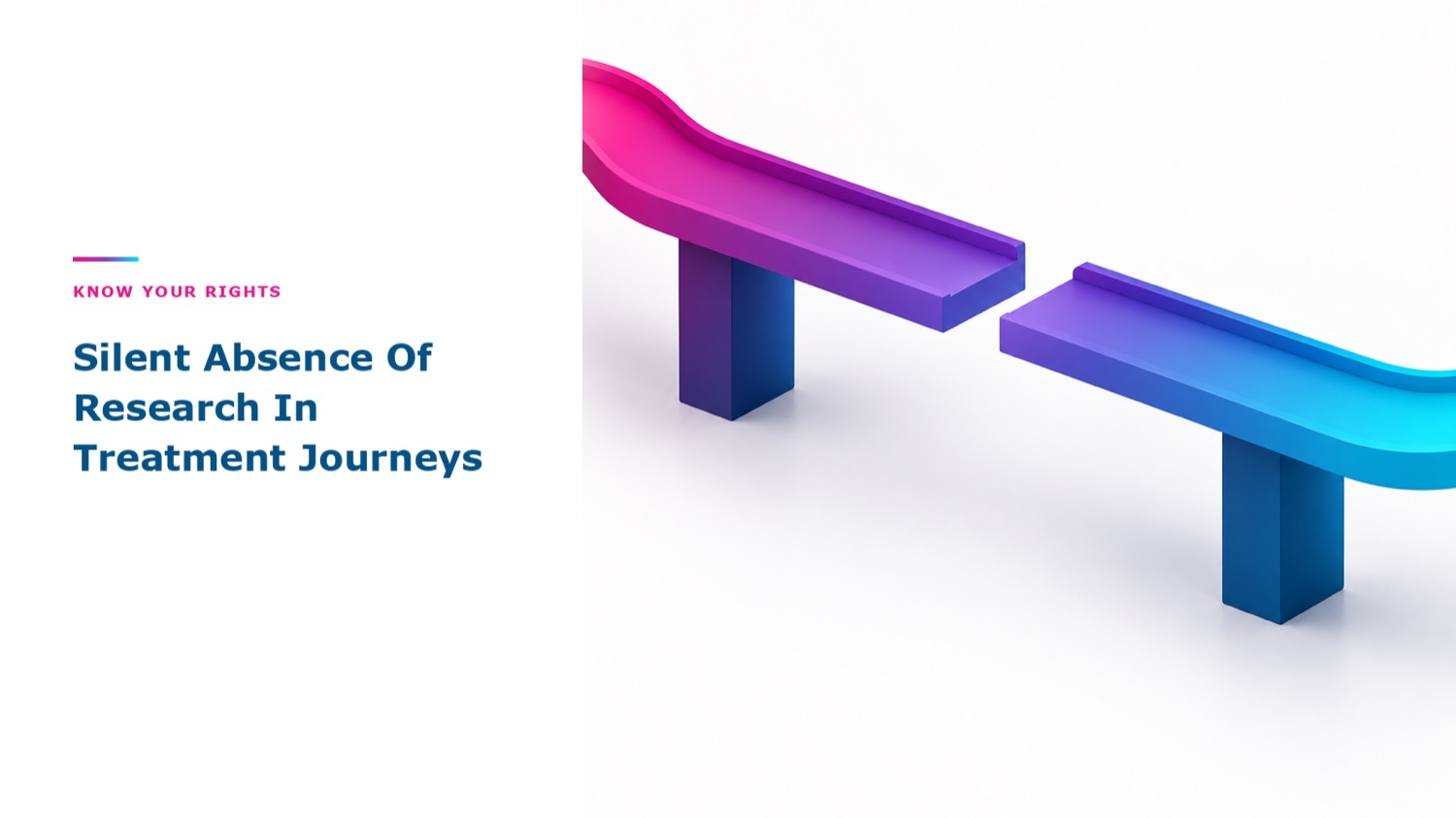
Treatment journeys unfold through a series of appointments, leaflets, and decisions made under pressure. For many people, research is never presented as a normal part of that pathway, and by the time a clinical trial is mentioned, especially in the UK, it can feel sudden, rushed, or positioned as a last resort rather than one option among several. Consent forms are thorough and clinicians aim to be clear, yet there is often a quiet absence of context about what research would mean for everyday life. That absence is rarely intentional, but its impact can be significant.
Gaps in information are common and usually unintentional, because clinicians are time limited and research teams focus on protocol delivery, but patients are often not fully supported to understand the wider context, including what alternatives exist, why a specific trial is being offered, and what participation will truly demand in real life. Patients frequently report that they understand the purpose of a trial but feel less prepared for how participation fits into their broader treatment journey. Questions about emotional impact, daily routines, and long term implications may not be fully explored. This gap can leave patients feeling uncertain, even when they are motivated to contribute to research. Addressing this silence requires empathy and a willingness to look beyond formal requirements.
Discussions around clinical trial research gaps often focus on data or representation. Less attention is given to gaps in communication and lived understanding. Patients are usually told what a trial aims to measure and what procedures are involved, but they are not always told the full practical reality upfront, such as screening failure rates, the emotional impact of uncertainty, the burden on family life, what happens if the trial stops early, or what support is available if participation becomes overwhelming. These are not small details, because they shape trust and confidence, and when patients sense that key realities were not clearly communicated, it can leave them feeling unprepared, even if consent documents were technically complete.
What Patients are Rarely Told When Enrolling
Enrolling in a clinical trial involves more than meeting eligibility criteria. People are rarely told that feeling unsure after signing consent is common. Consent is treated as a clear decision point, yet understanding continues to evolve throughout the study. Participants may discover new questions weeks or months after enrollment, and this can create anxiety if they feel those questions should have been asked earlier.
Another area often underexplained is the emotional rhythm of a trial. There may be periods of intense monitoring followed by long stretches of waiting. Patients can feel forgotten during quieter phases, even though the research process is ongoing. Without preparation, this ebb and flow can feel unsettling.
There is also limited discussion about how trial participation interacts with personal life. Travel, time off work, and family responsibilities are mentioned, but the cumulative effect is not always explored. Patients may underestimate the mental load of balancing research visits with daily life. A more holistic conversation could help set realistic expectations and reduce stress.
Clinical Trial Recruitment UK and the Need for Clarity
Within the context of clinical trial recruitment UK, there is growing recognition that informed participation goes beyond information sheets. Recruitment efforts are increasingly focused on accessibility and inclusion, yet clarity about the patient experience remains uneven. Patients may agree to join without fully understanding how research fits alongside standard care.
This lack of clarity does not reflect a lack of care. Clinicians and researchers work within tight timeframes and regulatory structures. However, when information is delivered primarily through documents rather than dialogue, important nuances can be lost. Patients may hesitate to voice concerns, assuming they should already understand.
Improving clinical trial recruitment UK therefore involves listening as much as explaining. When people feel safe to ask about uncertainties, trust grows, and understanding earlier means fewer people discover mid-study that participation does not fit their lives. Eligibility is not the same as readiness, and a trial that respects both keeps more of the people it enrolls.
How trialport Supports a Fuller Picture to Close Clinical Trial Research Gaps
trialport aims to reduce clinical trial research gaps by offering clearer explanations, self-reflection tools, and structured trial information, so that when someone finds a study that may be relevant, they have a fuller picture of the “why,” the “what,” and the “what it will feel like,” not just the eligibility criteria. Whether they are eligible is a question for the study team. Whether they are ready is a question only they can answer.
The approach recognizes that people need more than factual answers. They need space to understand how research fits into their lives. trialport offers educational content, prompts, and supportive language that acknowledges uncertainty as a normal part of decision making. This helps people feel less alone in the process.
By presenting information in stages, the platform allows understanding to grow over time. Patients are not expected to absorb everything at once. This staged approach reflects how people actually process complex decisions, especially when health is involved.
Building Trust Through Empathy and Openness
Addressing the silent absence of research context does not require blame. It requires empathy and openness. Patients benefit when research teams acknowledge that some aspects of trial participation are hard to explain and harder to predict. Honest conversations about uncertainty can be reassuring rather than alarming.
Tools that support these conversations play an important role in modern research. When people understand the whole picture, they ask better questions, raise concerns earlier, and are less surprised by what participation asks of them. This benefits both the individual and the research itself.
The future of patient focused research lies in recognizing what has gone unsaid and gently bringing it into view. If you want to see what research options may exist for your condition, start with what participation could involve, or see how the pathway works.
About the author
Keith Berelowitz has spent more than twenty years watching clinical trials work on paper and struggle in real life. He has helped run studies, advises sponsors and CROs on how they engage with people, and chairs a UK research ethics committee, where consent forms and participant information sheets cross his desk every month. That vantage point led to one conclusion: most trial problems are not failures of science. They are failures of understanding at the moment a person decides.
He founded trialport, a clinical trial navigation and decision-support platform, on a principle he brings from the ethics committee: clarity is an ethical issue, not only a communication one. People should understand what they are being asked to consider before they are asked to decide. Understanding comes first. Decisions follow.