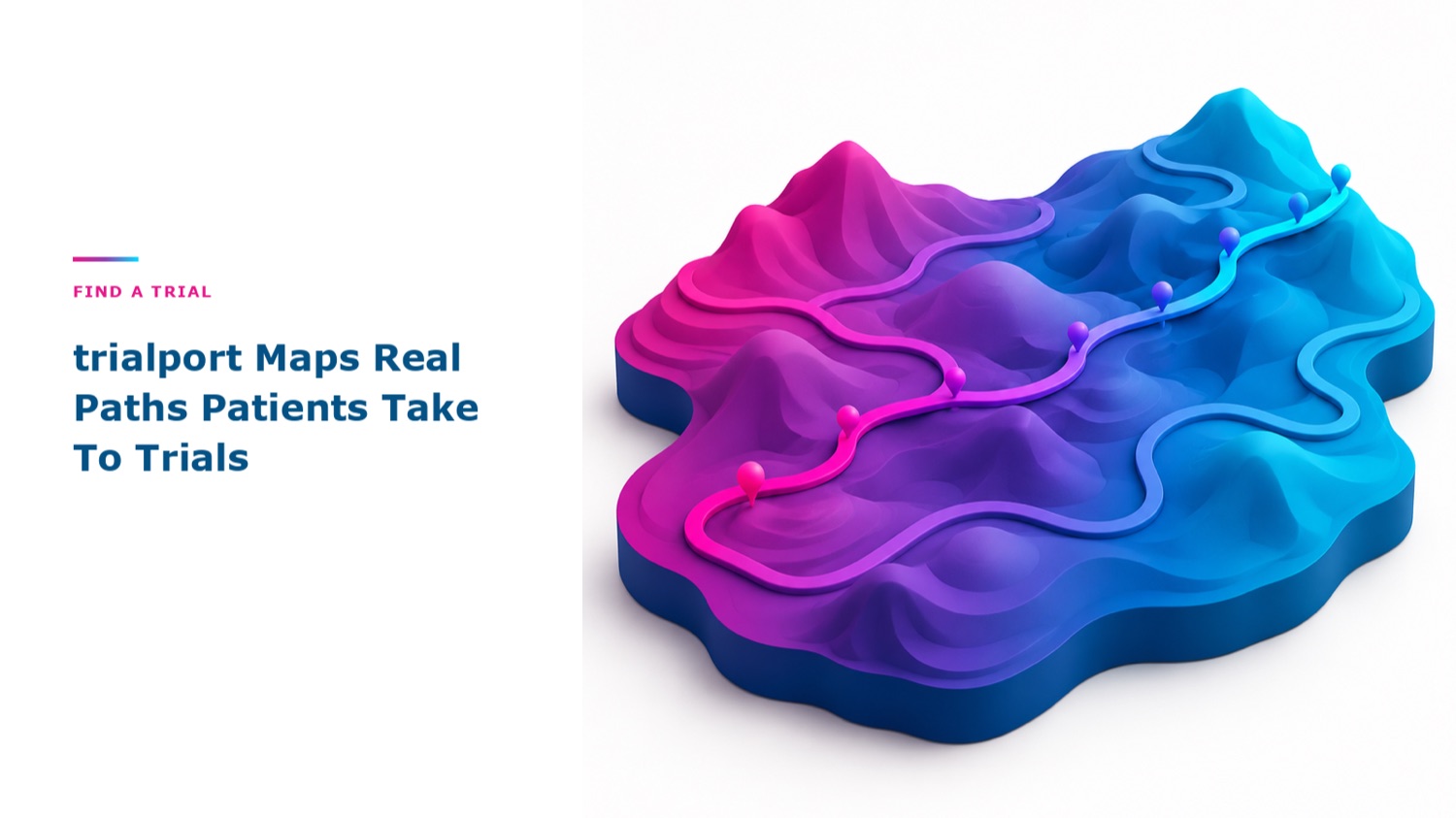
Clinical trials do not begin when a consent form is signed. They begin much earlier, often at diagnosis, when people are trying to understand their condition and their options. Research shows that most people who are eligible for a trial never enroll, not because they are unwilling, but because the path from diagnosis to a suitable study is unclear, fragmented, and full of handoffs between clinicians, specialists, and support networks before research even enters the picture. trialport maps those real paths so the barriers can be seen and removed.
Patients do not move through the healthcare system in a single, predictable way. Reference data from patient advocacy groups, healthcare systems, and trial sponsors shows several common routes patients take before they ever hear about a trial. Understanding these routes is essential for improving recruitment and ensuring trials reflect real patient needs. When engagement platforms are designed around lived experience rather than assumptions, participation becomes more realistic and more inclusive.
Platforms like trialport are built to connect these disconnected moments. By aligning plain-language study summaries, the medifit™ + readifit™ self-reflection tools, and support resources with how people actually move from diagnosis to decision, trialport helps turn early uncertainty into informed trial readiness.
Common Patient Paths from Diagnosis to Trial Awareness
Reference data highlights several patterns that appear across disease areas. One common route is the specialist-led path: diagnosis, referral to a specialist center, stabilization on standard of care, then trial discussion once treatment response and eligibility timing become clear. This path begins in primary care or a specialist clinic, where a diagnosis is delivered with limited discussion of research options. People often leave with questions and search online for clarity. In this path, awareness of trials depends heavily on search results, patient forums, and condition specific organizations. Without guidance, misinformation or fatigue can stop progress.
Another frequent route is the community-led path: diagnosis, then early learning through advocacy groups and peer networks, where trials are discovered through shared experience and word of mouth rather than through the clinic. This path involves patients who are already connected to advocacy groups. These patients tend to learn about trials earlier because advocacy organizations share study information and educational resources. Data shows these patients are more likely to trust trial information, yet they still face challenges understanding eligibility and next steps. Engagement platforms can support this group by translating complex criteria into plain language and guiding them towards relevant studies.
A third normal route is the “option-exhaustion” path: after multiple treatments or disease progression, patients begin actively searching for new options, which can make trial discovery urgent but emotionally and cognitively overwhelming. Patients who exhaust standard therapies often become more open to trials but are also dealing with emotional and physical strain. Reference data indicates that this group values clarity and speed. They need reassurance that a trial is appropriate and practical. Platforms that surface suitable trials quickly and explain expectations clearly can make a meaningful difference at this stage.
A fourth path involves patients referred directly by clinicians. While this appears straightforward, data shows that referrals often depend on individual clinician awareness and time constraints. Many eligible patients are never referred. Engagement tools that support clinicians with up to date trial information and patient friendly materials help close this gap and ensure referrals are consistent rather than incidental.
How trialport Supports Patient Focused Trial Navigation
Platforms like trialport support these paths by helping people find relevant studies earlier, understand what participation involves, and move from diagnosis to clinical trial sign up with more clarity, fewer dead ends, and less confusion. The strength of trialport lies in adapting to each of these paths rather than forcing people into a single funnel. Someone newly diagnosed may need plain-language explanations first, while someone exploring options after treatment failure may go straight to a study summary and the medifit + readifit self-reflection tools. Screening and eligibility remain with the site.
This approach reflects findings from patient engagement studies, which show that timing and relevance are critical. Patients are more likely to engage with trial information when it acknowledges their current concerns. trialport supports this by offering modular pathways that adjust as patient needs change. This reduces drop off and builds trust over time.
Importantly, trialport also captures engagement data that helps sponsors and research teams understand which paths are most common and where friction occurs. This insight allows trial teams to refine messaging, eligibility explanations, and support resources. Over time, this creates a feedback loop where patient experience directly informs trial design and outreach strategies.
Clinical Trial Sign Up and the Role of Informed Decision Making
For many patients, the moment of clinical trial sign up is the most daunting part of the journey. Reference data consistently shows that confusion around eligibility, fear of side effects, and concerns about time commitment are major barriers. These concerns are not signs of reluctance but signals that information has not been delivered in a usable way.
Platforms that guide people toward clinical trial sign up must prioritize informed decision making. This means presenting benefits and risks clearly, explaining what participation looks like in daily life, and offering opportunities to ask questions. trialport supports this by putting understanding before the first contact with a site, rather than treating sign up as a single step. Eligibility is confirmed at the site; readiness is built before it.
Data also shows that people who feel informed are more likely to remain in a trial once enrolled. Retention improves when expectations match reality. By mapping the full journey from diagnosis through enrollment, trialport helps ensure that sign up is based on understanding rather than pressure or confusion.
Building Sustainable Engagement Across the Trial Lifecycle
Mapping patient paths does not end at enrollment. Reference data highlights that support must continue throughout the trial lifecycle. People who feel supported during participation are more likely to complete studies and provide high quality data. Platforms like trialport extend that support beyond recruitment by offering ongoing communication and resources tailored to participant needs.
This sustained approach benefits both patients and sponsors. Patients gain clarity and reassurance, while research teams gain insights into engagement patterns and potential improvements. Over time, this leads to trials that are more patient focused and more effective.
As clinical research continues to evolve, understanding real patient journeys will remain essential. Finding people is not the same as enrolling them, and platforms that rely on reference data rather than assumptions are better positioned to close that gap. See what trialport does for sponsors and CROs.
About the author
Keith Berelowitz has spent more than twenty years watching clinical trials work on paper and struggle in real life. He has helped run studies, advises sponsors and CROs on how they engage with people, and chairs a UK research ethics committee, where consent forms and participant information sheets cross his desk every month. That vantage point led to one conclusion: most trial problems are not failures of science. They are failures of understanding at the moment a person decides.
He founded trialport, a clinical trial navigation and decision-support platform, on the view that finding a study is only the first step. A plain-language summary and the medifit™ + readifit™ self-reflection tools help people judge whether a trial fits their health and their life before they ever contact a site. Understanding comes first. Decisions follow.